• Sam’s Sandwich Rules

    Okay, I’m just making this clear, but Stewart is not writing this.  You are actually reading the work of his son Sam, who very politely asked to write an article.  I think I’m averaging a B- in English right now so I’m not sure how this is going to work out.

    I think we can all agree that we have all made at least 8 dozen sandwiches in our lives.  I’m not quite there yet, but I’m sure I will be at that marker soon enough.

    You can make a sandwich out of basically anything.  I once made a “ketchup, pickle, and mixed nut sandwich”.  Better than it sounds, but definitely not something you want to make on a regular basis.  Draegers, one of our local grocery stores, has a tuna and egg salad sandwich, which is a double decker hunk of extreme awesomeness, no joke.  The cream cheese and jelly sandwich is a semi-popular meal often sent with second graders to school for lunch.  It starts off tasting good, but after a couple weeks of it you start to get that “if I have another bite of this I’m gonna barf” feeling.

    Sandwiches are so common these days that we take them for granted.  But who had the great idea to put cheese and ham in between two pieces of bread?  Believe it or not, the sandwich was made by accident.  A long time ago a couple of people were playing cards.  It was about lunchtime, and they were hungry.  One player wanted to eat, but also wanted to continue playing, so he asked for his meal between two slices of bread, so he could eat it with one hand.   Without thinking, he invented the sandwich.

    There are many kinds of sandwiches you can make.  There are no restrictions, but here are a few tips.

    –       If you want a healthy sandwich, go for whole wheat bread, but if you want it to taste better, use white or rye bread.

    –       Grilled cheese tastes better with mustard.

    –       Toasting the bread adds flavor.

    –       Ketchup should not be a main component of any sandwich except for burgers.

    –       PB&J or turkey and cheese sandwiches make the best sandwiches for school lunches.

  • Super Bowl Sliders

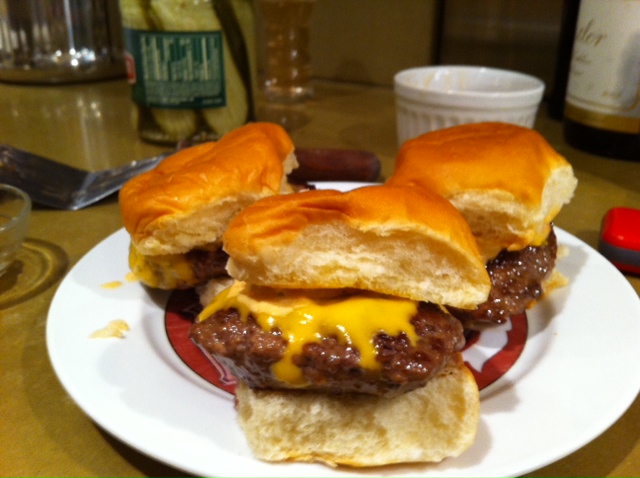
    We are big burger fans at Putney Farm, but we rarely make them at home. The reason is simple, we tend to go out for things we can’t make better at home. We have a good local burger joint that grinds and seasons their own meat, cooks it right and has beer and milkshakes. We really like (and the kids love) the burgers, and we enjoy supporting the business.

    But the Super Bowl is coming and the boys want burgers with the game, so we have been working on our own burgers. And it has been an adventure. We have tried all sorts of stuff; grinding our own meat, mixing different cuts and fats, different temps, different buns, sauces, etc. So far, we have a few (perhaps heretical) takes on a good burger:

    –       If you have a good butcher, grinding your own meat is a waste of time

    –       Ground chuck is still the best choice at home

    –       The bun matters as much as the beef

    –       The sauce from the Shake Shack in NYC (or a home version) would make a tennis shoe taste good

    As for grinding you own meat, it is great fun until you need to clean up. But a good butcher will do it for you- just buy the cut and ask for it to be ground. Or simply ask if they grind their meat daily- if they do, you are all set. If your butcher can’t give you what you want, find another butcher. A butcher is a lifelong relationship, make it a good one.

    Unless you are tight with Pat LaFreida (or live in NYC where you can get his burgers at the market), just use ground chuck. Many foodies will tell you it is easy, but home blending and grinding of different cuts is something you need to work at. The variables include quality / grade, fat %, what cut the fat comes from, temperature, part of the cut (brisket? point or flap or both?), coarse or find grind, etc.  Not simple, not fun and not necessarily “better”.

    The bun? A lot of the sweetness comes from the bun. So we base our burger on a commercial bun we really like, King Hawaiian Rolls, they are soft, yeasty and sweet- a perfect fit for a burger. The rolls are small, so we started making sliders. The kids love the size and it is nice to have the option to serve the slider as a snack or appetizer.

    As for the Shake Shack sauce, it is simply awesome. Many have waxed poetic on the sauce- so no need to do so here. Just use it. Serious Eats reverse-engineered the sauce (here), and we added smoked paprika and salt to fit our tastes. It is incredibly easy to make.

    Our kids like our sliders with the sauce more than burgers from our local joint. Success!

    Super Bowl Sliders:

    (sauce adapted from Serious Eats)

    What you get: Tasty, juicy sliders that can be served as snack, appetizer or main course. The presentation is also good.

    What you need: No special equipment required. Good sharp pickles will help in the sauce.

    How long? 30 minutes, max. This is an easy dish you can make any time.

    Ingredients:

    (makes 8 sliders, you will have extra sauce)

    Burgers:

    –       16 oz. ground chuck, formed into 8, 2 oz. patties that are less than ¼ inch thick.

    –       4 slices of American cheese, tear into 8 pieces

    –       Salt

    –       1 tablespoon bacon fat or vegetable oil

    –       2 tablespoons butter

    –       8 dinner rolls (King Hawaiian if you can get them)

    Sauce:

    –       1/2 cup mayonnaise

    –       1 tablespoon ketchup

    –       1 tablespoon yellow mustard

    –       4 slices kosher dill pickle, chopped

    –       ½ teaspoon kosher salt

    –       1/4 teaspoon garlic powder

    –       1/4 teaspoon smoked paprika

    –       Pinch cayenne pepper

    Assemble:

    1. Place all sauce ingredients into a food processor, blend until smooth (immersion blender will also work). Set aside.
    2. Split rolls and put a small amount of butter on each roll. (Optional: grill each roll, butter-side down, while you make the sliders for extra crunch)
    3. Heat a heavy skillet (cast iron is good here) over medium-high heat. Make sure it is hot.
    4. Place 4 burgers in the skillet. Add pinch of salt to each burger. Cook for 2 minutes. Flip burger and add cheese. Cook another 2 minutes. Set aside, under foil, to rest. Repeat with second batch of burgers.
    5. Place burgers on buns and add sauce, to taste. Serve.
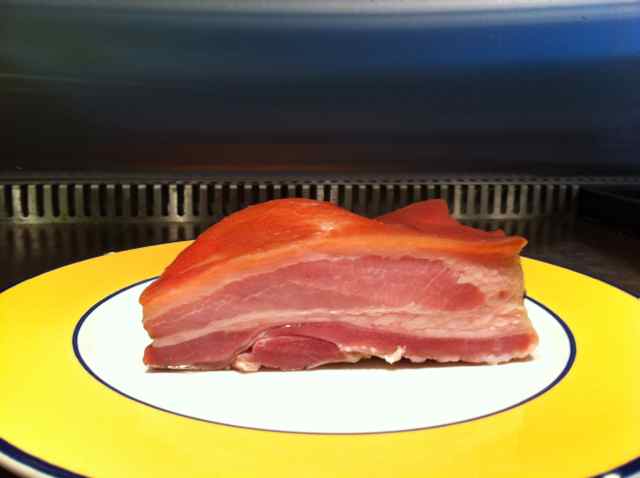
  • Make bacon at home. Have a BLT. Smile.

    A few weeks ago I was perusing Michael Ruhlman’s excellent cooking blog (Ruhlman.com) and came across a quote that piqued my interest:

    “No excuses, if you like to cook, for not curing your own Pancetta”

    Actually, I can think of many excuses for not curing my own Pancetta: Other cooking priorities, a 24-hour day, a good local supplier, fear of poisoning family, etc.

    But one thing I am learning, as I try to expand my cooking skills, is not to dismiss passionate statements like the one above. I will write more on passion and food, but I am finding that if an experienced, and thoughtful, chef like Ruhlman says something this definitive, he means it. Now at times, foodies can make passionate statements about everything (this may be why many people find foodies annoying). Random, and sometimes misinformed, passion can lead to a lot of blind alleys and poor, wasteful cooking. But I took Ruhlman at his word, and I am glad I did.

    I did make one change and start with Bacon, rather than Pancetta. It turns our both are cured pork belly, but Pancetta is air-dried while bacon is cooked and/or smoked. Other differences between bacon and pancetta include accents to the cure (sugars, herbs, garlic, spices, etc) but these accents are really under the control of the cook. The one step that may be a barrier to home-curing is the need to buy “pink” curing salts. Ruhlman gives you an internet source and I ordered it for $2 and it took a few days to arrive. I now have enough for dozens of cures.

    You want this, you really, really do...

    In all honesty, I chose to start with home-cured Bacon because it takes less time and we could not figure out where to hang Pancetta without our cat taking early samples. But the first attempt with Bacon was such a success that we will be making more of our own Bacon with different cures and smoke. Carolyn already wants a maple-syrup cured Bacon and it is easy to do! We will also make Pancetta, we just need to rig a drying setup that defeats the cat.

    Once our Bacon was made, it turned out to be the basis of a surprising off-season meal- BLTs! We had a decent hothouse tomato, (yes, yes I know it is winter but it is a local product from the farmers market, jeez), Ecopia Farms lettuce (the best in the world, seriously, more on this later) and Carolyn made a loaf of wheat bread that morning. What a gal, sigh.  The sandwiches were a great treat and it all came together because we made the bacon. Thanks Ruhlman.

    Home Cured Bacon:

    (Adapted from Michael Ruhlman)

    Notes before you start:

    –       Find somewhere you can buy pork belly. A few calls to your local butcher shops should work, but it is not as easy to find as one might think. Internet mail order is also an option.

    –       You can use pork belly with skin on or off (you may not have a choice) but if you do not want to use the skin, it will be useless added weight.

    What you get: Very tasty bacon that has sweeter, cleaner flavor with very little shrinkage. Great for all traditional bacon uses. The bacon can be thickly sliced and served by itself as an appetizer. If you have been to the famous Peter Luger steakhouse in New York and had their bacon appetizer you will get the same experience at home- friends and family will rave.

    What you need: The only special equipment required is curing salt (sodium nitrites)- which is safe in the small amounts used, it should be kept away from children. Otherwise you need a few sturdy 2- gallon ziptop plastic bags or a big plastic container(s). Space in the fridge for 7 days for curing. An accurate meat thermometer and a scale are very helpful.

    How long?: 10 minutes of prep. 7 days of curing. About 3-4 hours of cooking or smoking time. If you start on a Saturday morning you can have bacon the next Saturday evening and you will be ready for a truly awesome Sunday brunch.

    Ingredients:

    –       5 lbs. fresh pork belly. Skin-on or skin-off. It is OK to slice the belly into pieces to fit in your bags / containers.

    –       2 oz. Kosher salt (1/4 cup), Kosher salts vary in size of crystal- using weight is better.

    –       2 teaspoons pink curing salt #1 (see here for source)

    –       4 bay leaves, crumbled

    –       4 tablespoons coarsely ground black pepper, freshly ground if possible

    –       1 teaspoon freshly grated nutmeg

    –       ¼ cup dark brown sugar

    –       1-2 cloves of garlic, peeled and smashed with a knife. The garlic shows in the final product, if you do not like garlic or the cloves are large- adjust to taste.

    –       5 sprigs fresh thyme (optional- we love thyme and use it, it adds a very savory note)

    Assemble:

    1. Thoroughly mix salt, curing salt garlic and all the herbs/spices in a medium sized bowl.
    2. Add pork belly to bags or plastic container.
    3. Add curing mix to containers- rub onto belly. Take you time and get an even coating.
    4. Seal container / bags. If using bags, seal and place on a sheet pan. Add to fridge. (It is wise to add a post-it note with date and time).
    5. It takes 7 days to cure, halfway through cure open containers and spread out the cure again on the meat. You will see some liquid has been drawn from the belly- this is fine. Keep the liquid or drain.
    6. After 7 days, take out the belly and rinse with cold water.
    7. To finish bacon, preheat oven to 200 degrees (you can also smoke the bacon- but that is another recipe). Place belly on a sheet pan or rack on sheet pan (better). Cook until internal temp is 150 degrees. This may take up to 4 hours depending on the size of your piece of belly.
    8. Slice it up and cook it! Eat, repeat.
  • Greens gone wild!

    We are just getting going with the garden for spring, but the plants sometimes have a mind of their own. This is what we have now:

    This is 3 feet across!

    I have no idea what it is (Kale?) but it likes a mild winter. Here is another pretty shot:

    Flower?

  • When life (and winter) gives you lemons…

    L to R: Meyer 75, California Artillery Punch, Meyer Lemondrop, Meyer Lemonade

    Lets face it, if you like seasonal food winter can really suck. We like kale and parsnips as much as the next guy, but they get old pretty quick. By the time February rolls around, we have already made numerous roasts, soups, stews and bean dishes, awesome food, but still very “wintery”. At this point in winter we often crave some brighter flavors.

    Happily, we do get citrus in the winter and in California that often means Meyer lemons. Meyers are thought to be a hybrid of lemons and oranges or mandarins. Meyers tend to be sweeter and less acidic than the standard supermarket Eureka lemon. It is this sweetness and low acidity that makes Meyer lemons a great lead element in lemonade and cocktails (nothing brightens winter like a cocktail;-). While the Meyer is still very much a lemon, the softer flavors are often more full and “citrusy” than simply sour. This can make for more accessible and inviting lemon-based drinks. So if you (or a friend) think lemon-based drinks are too sour, try it with Meyer lemons and you may be pleasantly surprised.

    Like many Californians, we have our own Meyer lemon trees and they are very productive. Like all seasonal ingredients, this means when you get something you often get a lot at once.  The Meyer lemons will ripen over a few months in winter but every week or so we pick a batch. Meyers are also easy to find at farmers markets and many gourmet groceries at this time of year.

    So what to do with a dozen Meyer lemons? We make Meyer lemon syrup as a base for lemonade and cocktails.  This syrup is easy to make and has deeper flavor from the oils in the zest. There is no water in this syrup, just lemon juice, lemon peels and sugar. We will start with the Meyer lemon syrup and then move to a few drink recipes:

    Meyer Lemon Syrup:

    What you get: An easy and flavorful lemon-based syrup for lemonade and cocktails (sours, punches, collins, etc.). The extra muddling step extracts oils from the lemon zest for a much richer, fuller flavor. It is worth the time. This syrup features Meyer lemons, but all lemon varieties can be used.

    What you need: Special tools can include a juicer or lemon reamer. These are not required but will get you more juice in less time. A good peeler will help get the zest without too much pith, but a sharp knife (and practice) will also work.

    How long? Peeling and juicing will take 5-10 minutes. 1 hour of inactive time. The syrup will keep for a week, covered, in the fridge.

    Notes before you start:

    –       You are aiming for 16 oz. of juice. Usually this is 8-10 medium Meyer lemons, adjust the amount of lemons by the size. If you come up short on juice- simply match the volume of sugar to the volume of juice.

    –       If you don’t have superfine sugar, process a pound of regular sugar in the food processor for 60 seconds- presto, superfine sugar. Without superfine sugar, the sugar will not dissolve in the juice. If you can’t get superfine sugar, you can heat the mixture at low heat in a saucepan to dissolve.

    –       When juicing the lemons (or any citrus) with a juicer or reamer do not overdo it and press too hard on the fruit- you will start grinding bitter pith into the juice. This may seem a bit obsessive, but it makes a big difference in flavor. Take it easy.

    Ingredients:

    (makes 24-32 oz. of syrup)

    –       8-10 Meyer lemons (16 oz. juice), peeled with as little white pith as possible.

    –       1 Pound of superfine sugar

    Assemble:

    1. Place the sugar and lemon peels in a large bowl. Muddle with a muddler or heavy spoon to extract oils from the peels. Let sit for an hour and muddle again.
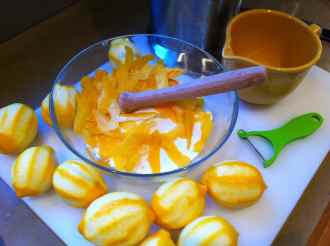
    2. Juice or squeeze 16 oz. of lemon juice.
    3. Add lemon juice to sugar mixture. Stir and then let sit as sugar dissolves. Once dissolved, strain out peels.  You now have Meyer lemon syrup

    Once you have the Meyer-lemon syrup you can easily make some great drinks. Let’s start with lemonade, either sparking or still:

    —-

    Meyer Lemonade:

    What you get: Ass-kicking lemonade with fuller flavor due to the oils from the zest that end up in the syrup. Cooks Illustrated has a similar approach to their “best” lemonade recipe. This lemonade does not disappoint.

    What you need:  No special tools required.

    How long?: If you have made the lemon syrup, 1-2 minutes. You can build a single drink or a pitcher in the same timeframe.

    Ingredients:

    (use this basic ratio for any amount)

    –       1 Part Meyer lemon syrup

    –       3 Parts still or sparkling water

    Assemble:

    1. Mix lemon syrup and water. Stir. Adjust for sweetness if you like.
    2. Add ice. Think summer. Give this to your kids for extra smiles.

    ——

    As for cocktails, you now basically have an awesome sour mix that can be used in sours and collins drinks. But here, we will offer a few cocktails and a punch using Meyer lemons instead of Eurekas. The cocktails are a Meyer 75, based on the French 75 and a Meyer Lemondrop. The punch is California Artillery Punch, adapted from Chatham Artillery Punch.

    Meyer 75 Cocktail:

    The Meyer 75 is an adaptation of the French 75 (it is a “75” if you use gin, a “76” if you use vodka). The sweeter Meyer lemon juice plays really well with the gin and the tartness of the Champagne.

    What you get: A slightly strong but refreshing cocktail with a full range of flavors and elegant presentation. Easy to assemble.

    What you need: Meyer lemon syrup (see above). No special tools. Champagne flutes are a nice presentation option.

    How long? If you have made the lemon syrup, this is a fast drink to make and a great way to impress guests with minimal effort. Assume 1-2 minutes to make the cocktail. If serving a large group, simply multiply the gin and lemon syrup mixture, pour into multiple flutes and then top each flute with champagne.

    Ingredients:

    (makes 1 drink)

    –       1.5 Oz Meyer lemon syrup

    –       1.5 Oz gin

    –       3 Oz Champagne or sparking wine (try brut rose’ for a new color, if you like)

    –       Lemon peel for garnish

    –       Ice cubes

    Assemble:

    1. Combine lemon syrup, gin and ice in a cocktail shaker or tall glass and shake/stir until very cold. Strain mixture into a champagne flute.
    2. Slowly top flute with the champagne. Garnish with lemon peel. Serve immediately.

    ——-

    Meyer Lemondrop:

    What you get: An attractive, very lemon-forward cocktail that is a good substitute for a Cosmo.

    What you need: Meyer lemon syrup (see above). No special tools. Martini glass is traditional

    How long? This is a another fast drink that will impress guests. Assume 1-2 minutes to make the cocktail.

    Ingredients:

    (makes 1 drink)

    –       2 Oz Meyer lemon syrup

    –       2 Oz vodka

    –       Ice cubes

    –       A few tablespoons of superfine sugar

    –       Lemon wedge for rim of glass

    –       Lemon peel for garnish

    Assemble:

    1. Wet edge of glass with the lemon wedge and dip the rim of the glass into the sugar.
    2. Combine lemon syrup, vodka and ice in a cocktail shaker or tall glass and shake/stir until very cold. Strain mixture into glass
    3. Garnish with lemon peel, if you like. Serve immediately.

    ——

    California Artillery Punch:

    (Adapted from David Wondrich)

    This is a great punch with deep, deep flavors- but it is strong stuff. Think of it as Long Island Iced Tea meets Meyer lemons. These will sneak up on you. This is the punch recipe, but we often make this drink as a cocktail using the same basic proportions- it works very well.

    What you get: Drunk, if not careful. But you will also a great punch with complex flavor from the four different types of booze, fruit and spice.  Despite all the booze, the citrus flavors and nutmeg will shine through. This is a great warm-up drink for holidays and parties.

    What you need: A big bowl. Cups. A ride home.

    How long? If you have made the lemon syrup this is a quick assembly. Ice, pour, mix, serve. 5 Minutes.

    Ingredients:

    (makes 30-60 drinks, depending on the cups you use.)

    –       1 full recipe of Meyer lemon syrup (see recipe above- this will be 24-32 oz. syrup)

    –       750 ml cognac

    –       750 ml rye or bourbon

    –       750 ml dark Jamaican rum

    –       3 Bottles of Champagne or sparkling wine

    –       Nutmeg

    Assemble:

    1. Fill your bowl with ice cubes (make sure you can still fit the punch)
    2. Pour in lemon syrup, cognac, bourbon and rum. Mix well.
    3. Add champagne and (gently) stir.
    4. Grate nutmeg over the top, to taste, and serve.