• Grilled Eggplant With Salsa Verde (And A One Lovely Blog Award!)

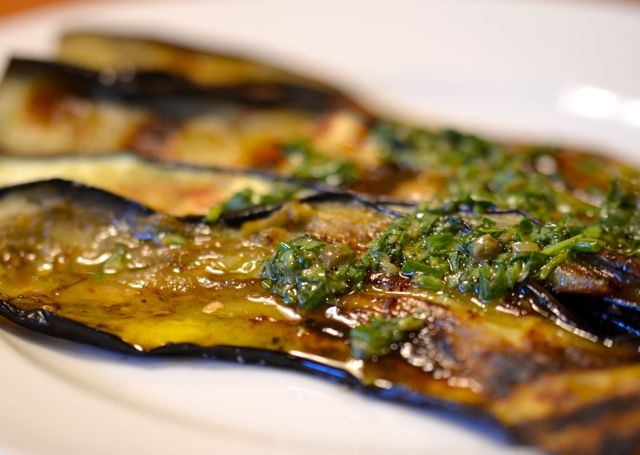
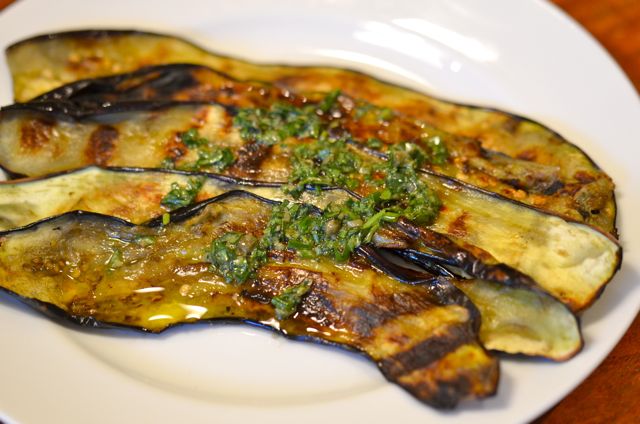
    Grilled eggplant with salsa verde.

    Recipe below, but please read on..

    We recently received a nomination for the One Lovely Blog award from our friend Erin at Erin’s DC Kitchen. We are big fans of Erin’s take on simple, tasty food and the overall positive spirit of her blog. Check out her site, it will be a pleasant visit. Thanks Erin!

    So now we must pass the award along to one lovely blogger and tell you seven things about ourselves (not sure there is much left, but we will try..;-). As for the nomination, we nominate Cooking in Sens, a blog about cooking and life in Burgundy. If we cook and take photos half as good, we would be thrilled. We love the blog and have made a few of the recipes with great success. Please check them out.

    So here are seven more things about us:

    1. We do read cookbooks for fun. And our kids are starting as well. Now we need to put them to work.
    2. As noted before, we have less success with zucchini than we should. Somewhat embarrassing.
    3. We buy too much kitchen gear, but are getting better…a little. Sort of. Maybe.
    4. Sometimes we cook simple food because we don’t want extra dishes.
    5. Once we got to 40, wine started giving us the occasional headache. Cocktails and beer took over at the farm.
    6. Sometimes there are so many gophers we (I) feel like Bill Murray in Caddyshack (and want to “solve” the problem with similar measures).
    7. We can’t wait for tomatoes and fresh corn…like it really bothers us it’s not here yet.

    Now back to cooking. The Grilled Eggplant with Salsa Verde recipe is a simple one, but worth sharing simply because it answers the question of what to do with eggplant. Such a beautiful vegetable (technically a berry, btw), but often many cooks just put it in Eggplant Parmesan or Baba Ghanoush. Both great dishes, but we like quick preparations and grilling the eggplant does the trick. As for extra flavor, salsa verde packs a big punch from the herbs and oil. It is great on many dishes and we use it often on fish, like this dish. But it is great on almost any grilled vegetable.
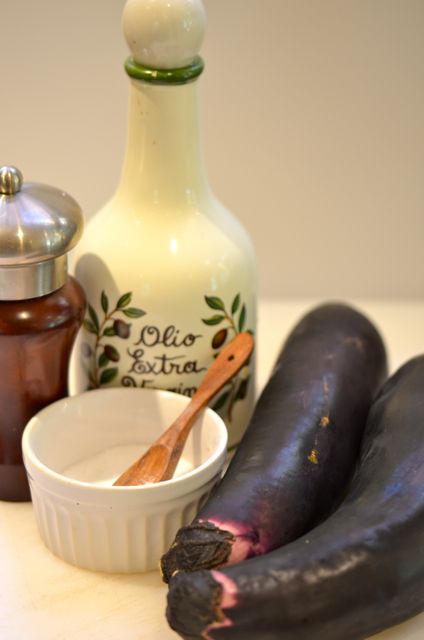
    Just a few ingredients for the eggplant.
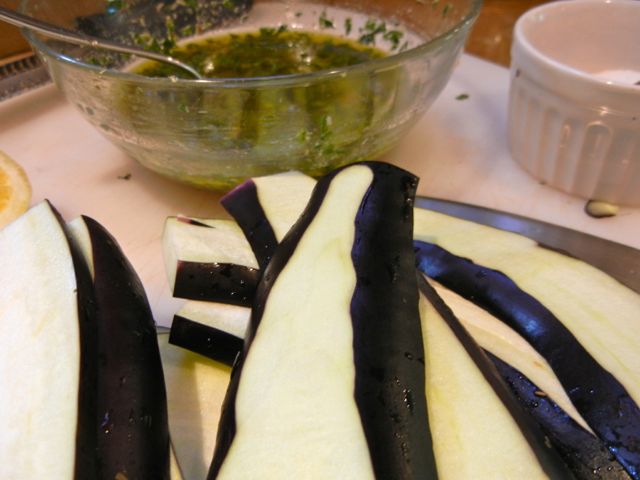
    Make your salsa verde and slice the eggplant.
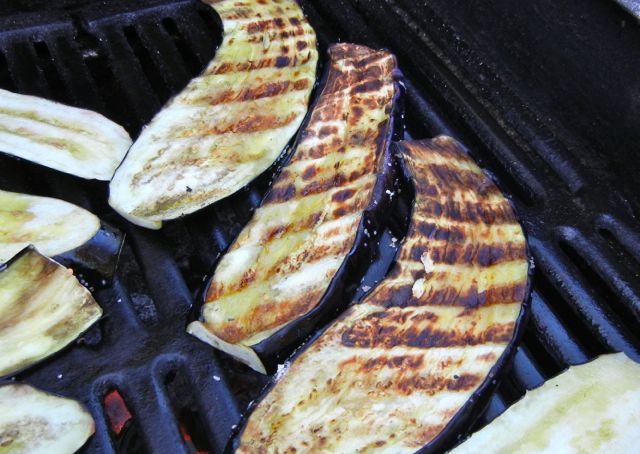
    Brush oil on the eggplant, sprinkle with salt and pepper and cook on a medium grill.

    Assembling and cooking this dish is as simple as it gets.  Most of the work with salsa verde is in chopping the herbs and then adding the oil and other ingredients. For the eggplant, simply slice it lengthwise into 1/4 inch slices and brush with olive oil and then sprinkle with salt and pepper. Cook on a medium grill until browned on the outside and soft in the center. The temperature here is key, if the fire is too hot the outside will burn before the center is soft. Lower the heat a bit and take your time. A grill pan indoors will also work, again use medium heat and take your time. You will still need less than 10 minutes. And then you can enjoy one lovely dish.
    Continue reading

  • Sushi Balls: Sushi At Home

    Sushi balls. Fun sushi at home.

    When we started writing this blog, one of the promises we made ourselves was to use the blog as motivation to cook new things at home. And so far we are making progress, but mostly with new tools like sous-vide and using “molecular gastronomy” ingredients in baking. But the next step was for us to explore new cuisines, and we went right for Japan.

    We love Japanese food and have a favorite local sushi bar and are even members in a Sake tasting club (great fun), but rarely cook anything other than tempura at home. But we decided that needed to change. So we bought Debra Samuels’ “My Japanese Table”, a cookbook with Japanese recipes adapted for the American kitchen. Samuels is a well-regarded food writer for the Boston Globe and lived /cooked in Japan for ten years, so we took the plunge. So far the cookbook is a good read, with plenty of simple recipes for Japanese basics like teriyaki and tempura. But we know what we wanted to do at home, sushi. And this recipe is why we bought the cookbook. Sushi balls are very pretty sushi that you can make at home. And its fun…really.

    Smoked salmon, salmon roe, seared ahi, shrimp, cucumber and shiitake mushroom.

    Usually the big issue with making sushi at home is actually constructing the rolls. Sushi rice is super-sticky and the shaping tools are uncommon for most home cooks. Without constant practice, home sushi can look like a train wreck. And while the flavor of the sushi can be good, the presentation is a big part of the dish. One way to handle this challenge is to simply prepare the rice and ingredients and then present them with nori as a buffet for hand-rolls. But with Sushi balls, anyone can make an attractive individual piece of sushi. You can even have fun and experiment with presentation.

    The trick is to simply place the fish or veggie on a square of plastic wrap, then place a tablespoon or so of rice on top (be sure to keep your hands moist with water when handling the rice).  Then bring up all the corners of the plastic wrap and twist tightly into a ball. When it unwinds, you have a well-shaped sushi ball. It only takes a few tries to get the hang of it, and then you can experiment with different combinations of ingredients. Samuels suggests cooked shrimp, lightly salted cucumbers and smoked salmon. We added some seared ahi, salmon roe and browned shiitake mushrooms. Cooked crab or scallops would also be very good additions. But feel free to experiment based on taste and budget (and this is an inexpensive dish).

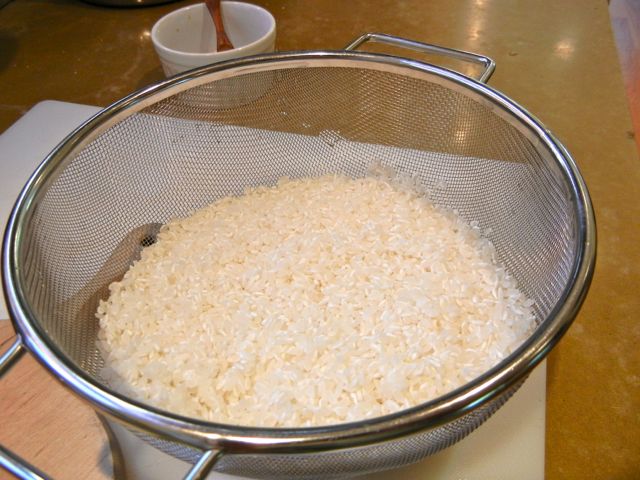
    Rinse the rice and drain.

    Ingredients for Sushi-zu seasoning

    Cooked rice, sprinkled with Sushi-zu seasoning.

    Now that shaping the sushi is less of a challenge, the real effort goes in making the sushi rice. While in sushi bars “mastering” the rice can take years, it is something you can do well at home- on the first try. The trick is to buy the correct rice and follow all of the steps. For the rice you need short grain japonica rice, which is available in most supermarkets. Don’t substitute long grain rice. As for the steps, you must rinse the rice and then either soak it for cooking or use a rice cooker- the recipe deals with both. While the rice is cooking you make the Sushi-zu seasoning of rice vinegar, sugar, salt and mirin. When the rice finishes cooking, you place it in a bowl and then gently sprinkle and mix the Sushi-zu seasoning with the rice. Then fan the rice to cool it down. The rice should stick together but not be mashed or “gluey”.  But if you use the right rice and follow each step you will get consistent, tasty, results.

    Slice cucumbers, sprinkle with salt, wait for 5 minutes and drain. Done. Continue reading

  • Chocolate Breakfast Muffins

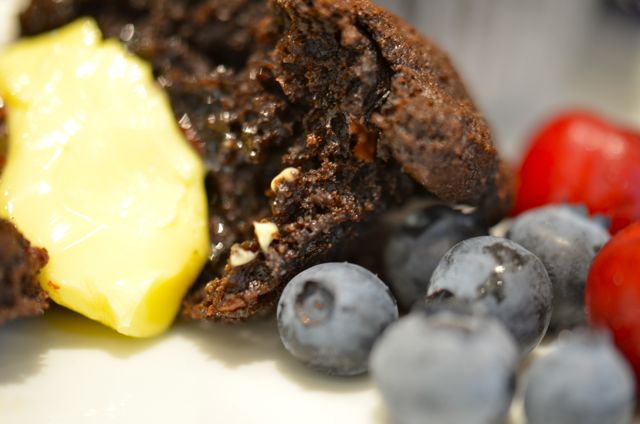
    Chocolate breakfast muffins with fresh cherries and blueberries.

    When is a cupcake not a cupcake? When you call it a muffin. And if you want to push things a bit more, you call it a breakfast muffin. Excellent. But whatever you call it, this is one fine muffin. Moist, chocolatey and filled with chocolate chips, these are hard to resist. And since we have been known to enjoy hot chocolate and chocolate croissants for breakfast at times (and perhaps even a slice of chocolate cake..;-), we don’t see any reason why we can’t have a chocolate cupcake muffin for breakfast every once in a while.

    These take less than 20 minutes to bake, but it is hard to wait.

    And just to tempt you a little more, these are very easy to make. Mix dry ingredients, mix wet ingredients, then combine them with some melted butter (of course). You don’t even need to beat the batter, just make sure it combines and then pour the batter into muffin cups and bake for 15-20 minutes.  Serve with fruit and, perhaps, more butter. A very happy breakfast, in less than 45 minutes.

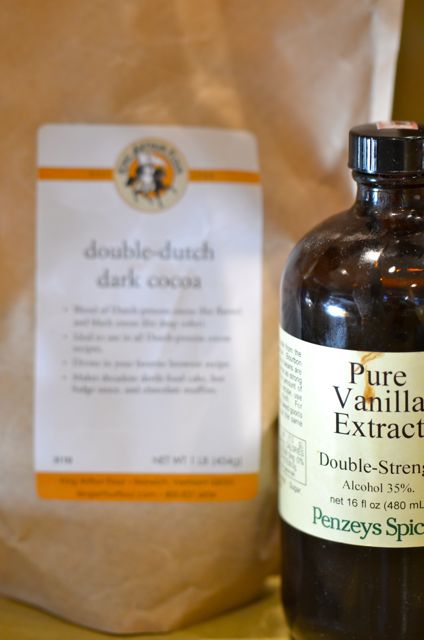
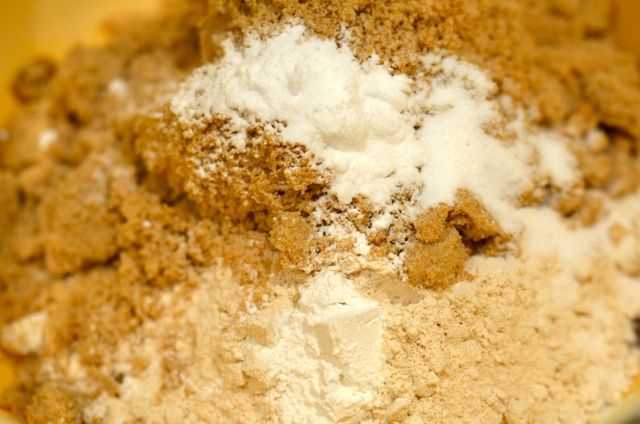
    Mix the dry ingredients.

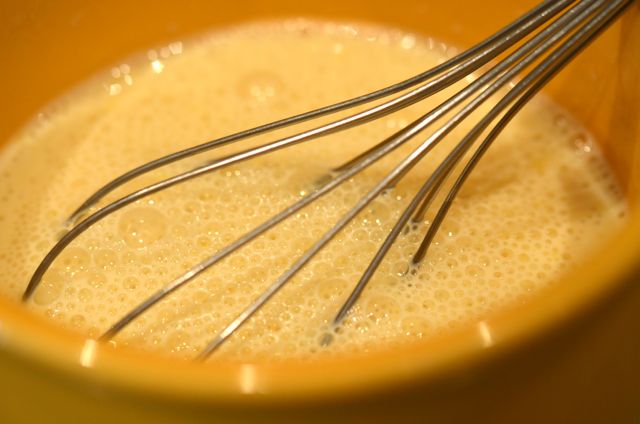
    Mix the wet ingredients.

    Combine into a nice batter and bake. Easy.

    And if you want to feel a little better about the recipe you can substitute white whole-wheat flour and fruit like dried cherries for the chocolate chips. We tried it, and it works just fine. So you can eat a chocolate muffin with some ostensible health benefits (or at least some guilt remediation). But since chocolate makes you feel like you’re in love, we think that is benefit enough.

    Continue reading

  • Radishes With Butter And Salt (And Moments Of Perfection)

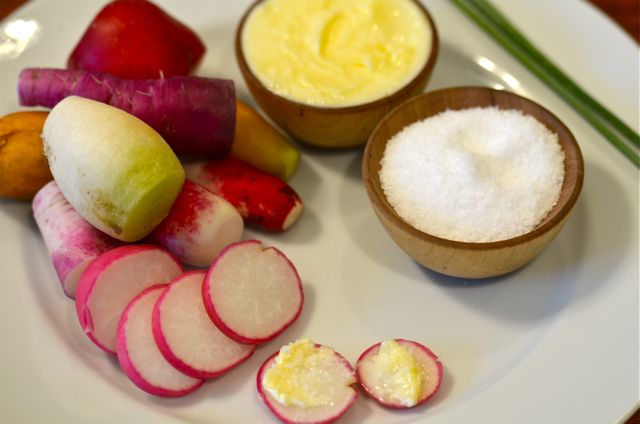
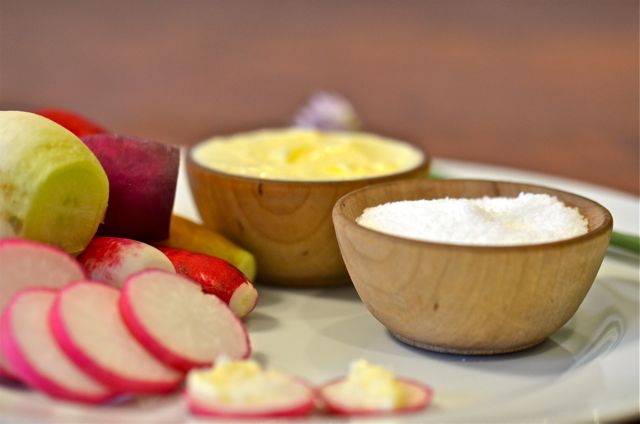
    Radishes with butter and salt, a perfect trio.

    Late post today. Our eldest and I went to the Giants game last night and stayed late to watch Matt Cain pitch the franchise’s first perfect game in 130 years. As we occasionally hint in the blog, all of us are lifelong Giants fans. We have seen Bonds’ home runs, All-Star games, Timmy’s Cy Youngs, World Series losses and (glorious) victory and everything in between. And there was nothing quite like the perfect game. Everything comes together in one game. A brief, brilliant spark of pure joy and surprise. And for the players it was the moment when the orchestra is perfectly in tune and the conductor is at his best. A sweet reward for a lifetime of effort.

    But in baseball, it is a lifetime of effort that is always filled with failure. Even the best baseball players fail, in some way, in almost every game. The best learn to accept failure and build more towards a lifetime body of work. That is what makes perfect games or championships so special. Not simply that you were the best on “X” day, but because the players must overcome failure to get there. Success is all the sweeter when reached through failure. You grow, you improve, you build.

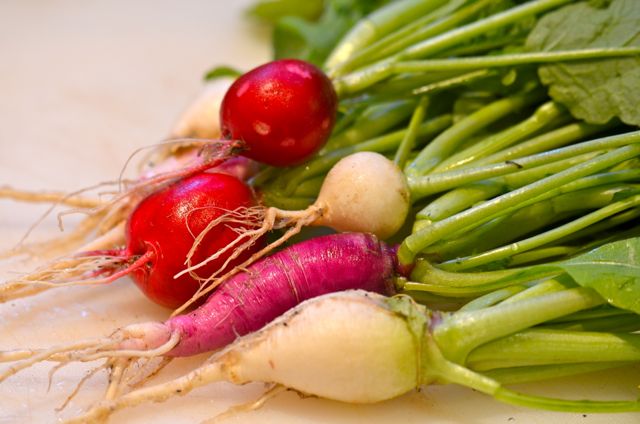
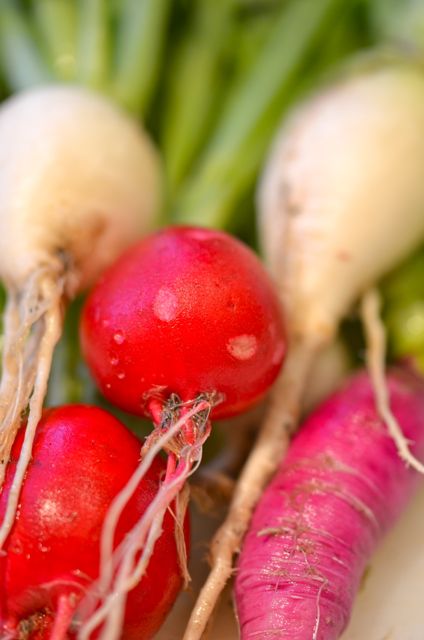
    Mixed radishes, fresh from our garden.

    If you garden or cook (or simply raise a family) this should ring true. While you may not toil in the spotlight, gardening and cooking are a lifetime of successes and failures. And some you simply cannot control. The beds were perfect, you checked the soil, picked the right seeds and watered on time. But the blight or frost came anyway. Green became brown. Fail. You picked the perfect recipe, shopped on time, did your prep and cooked like a pro. But the guests came late, one of the kids sprained an ankle and the roast stayed in the oven too long. Medium-burnt. Fail.

    But after a few well-placed “words”, you start again. There is always the next meal, day, week, season and year. And when the successes come they are sweet, and they are shared with those you love. When the cocktail is tasty and the guests are happily chatting, the kids eat the (perfect) fish and the dessert made from the fruit that you grew has been totally devoured, then you have it. A perfect meal, a perfect day, a perfect moment. And well-earned. And well-remembered. Think of those moments, and we bet you have a few that stick with you, and those you love, to this day. Brief, brilliant sparks of love, joy and content. The glow from those sparks lasts a long time.

    In the garden, harvest is often that special moment. This week we have cherries, berries and radishes. More on the fruit soon, but as for the radishes we will give you a “perfect” recipe to enjoy any time. Fresh radishes with butter and salt. How do we know it’s perfect? Because pretty much every celebrity cook, cookbook author and blogger has posted a version of this recipe at some time or other. But since we actually grew these radishes, we (selfishly) think we can post on it too. And it is a very tasty, and easy, dish.

    And we are big fans of radishes, both as cooks and gardeners. In the home garden radishes are a great crop. They grow to harvest in 3-4 weeks (the name comes from the Greek Raphanus meaning “quickly appearing”), work in many climates and compliment many cuisines. Radishes grow in spring and fall, so we stagger our crop over a few weeks to get radishes though most of both seasons. And, frankly, they are hard to mess up. While gardening is filled with failures, crops like zucchini and radishes do offer the opportunity for a few “quick wins”- and there is absolutely nothing wrong with that.

    While we like quick-pickling radishes or using them for crunch and heat in salads, we usually just eat them out of hand. We enjoy their crunch and light, peppery heat (the kids like them too, so that is a big bonus). Serving radishes with butter and salt simply creates a more balanced dish. The sweet, creamy butter and the salt add more dimension to the radish. And all you need to do is slice some radishes and put some butter and salt into a few bowls and serve. This is a great summer dish- easy, but full of flavor.

    Continue reading

  • Cooking Sous-Vide At The Farm

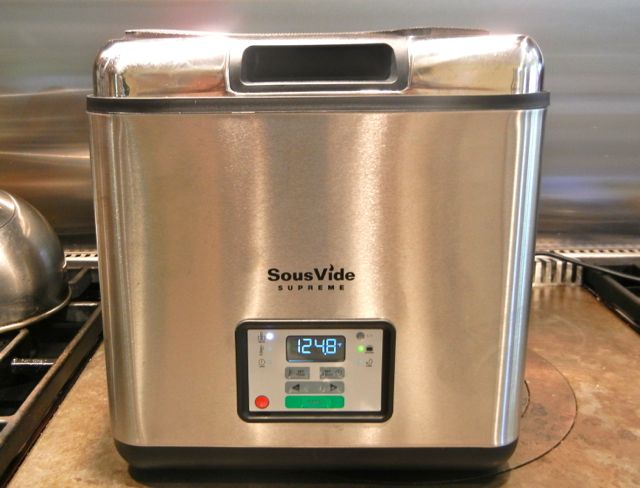
    Sous-vide cooker for the home. It works.

    The more we cook, the more we understand that time and temperature are the keys to good cooking. And it has always been this way in the kitchen. For generations good cooks understood that, for many dishes, low-and-slow transforms even the lowliest ingredients into the best meals. And we use our dutch oven, slow cooker and smoker in many meals to take advantage of low-and-slow, particularly for larger, tougher cuts of meat. We do like our beef brisket and pork shoulder.

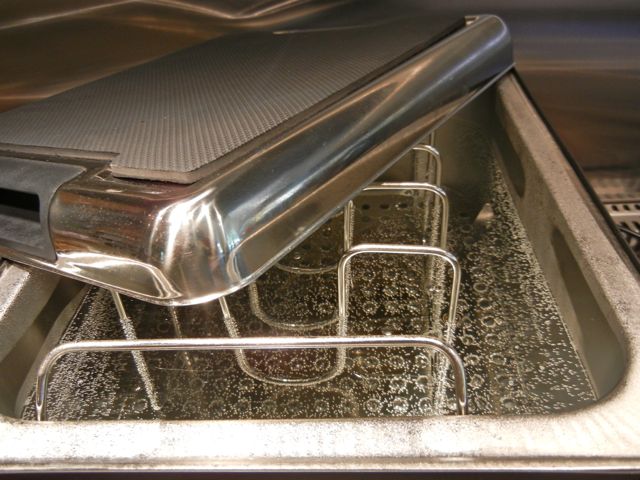
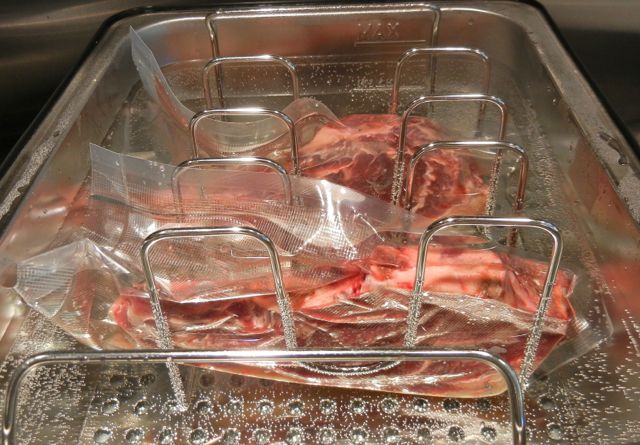
    Temperature-controlled water bath with racks to manage space.

    But when cooking steaks, chicken pieces or fish, the slow cooker or smoker are usually not practical options. Most of these meats are fried, seared or roasted in the pan and/or oven, or grilled on the barbecue. The problem with these high-heat methods is that the heat is applied unevenly on the meat. So even with good technique  you get a well-done exterior that moves towards the desired doneness in the center of the meat (assuming you don’t overcook the whole thing). The only real bonus of high-heat cooking is the extra flavor you get from browning / caramelizing. Most traditional cooking methods can’t fully overcome a fundamental challenge- how do we cook and brown this irregularly shaped food without overcooking it?

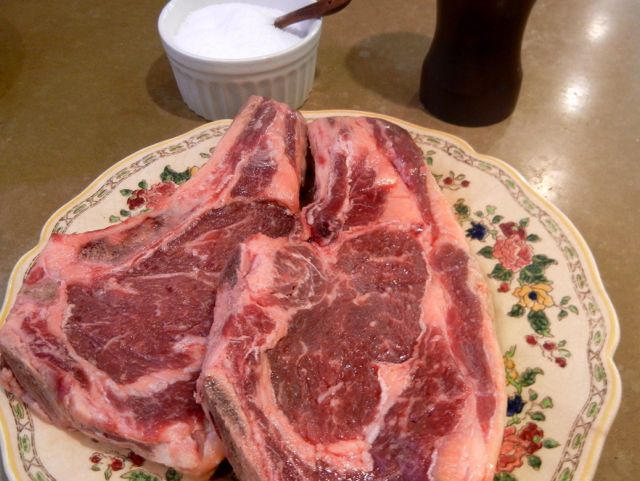
    Grass-fed ribeye steaks. These are real good- best not to screw it up.

    Sous-vide (French for “under vacuum”) cooking is a solution to this challenge. Basically a slow-cooker for individual cuts of meat, fish and poultry, sous-vide cooking gives the home cook exact control of cooking temperature that’s applied uniformly to the meat. And it works pretty much every time- as long as you have the time. The approach here is pretty simple, a water bath is heated to a specific temperature and the protein (or vegetable) is vacuum-sealed into a bag and the bag is placed in the water. The bag keeps the meat from leaking juices or breaking apart into the water bath. The proteins slowly, and uniformly, cook to the temperature in the water bath. Once done, the protein can be briefly seared to add the tasty browned flavors and improve appearance. It is a neat trick and it really works. If you ever wonder how busy high-end restaurants get their steaks or fish right every time, sous-vide is often the answer.

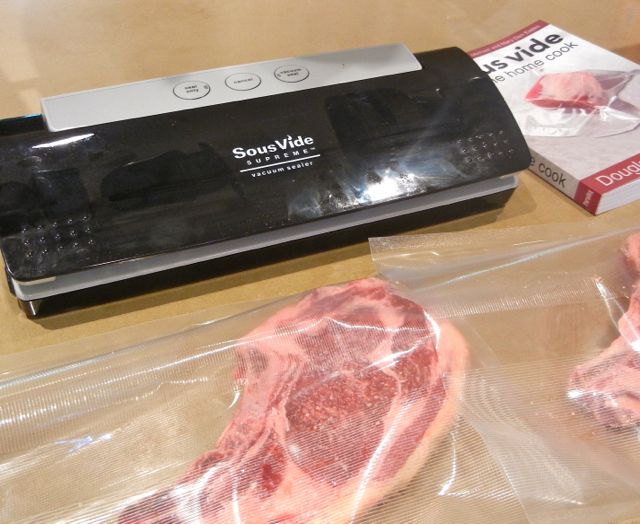
    Vacuum-sealing the steaks. This takes less than a minute.

    We’ve been reading Stefan’s Gourmet Blog and his results cooking sous-vide always looked great. And as we recently purchased 1/4 of a grass-fed cow from Stemple Creek Ranch, we wanted a cooking method that made the most of the flavor of the beef. So we took the plunge and bought a sous-vide cooker (we got one on sale, but expect the setup to run somewhere between $350 – $500, so it’s not cheap). So far we have tried cooking halibut, salmon and Stefan’s cod recipe. All were perfectly cooked.

    Cook for 1.5 – 2 hours at 125 degrees.

    The next thing we tried was making a good steak using sous-vide. Not ones to be cautious, we went right to making ribeye steaks. We followed the new procedure, sous-vide cook at desired temperature (in this case 125 degrees for rare-to – medium rare) for 2 hours and then sear the meat briefly to brown the surface. Frankly, the meat, while perfectly cooked, is very unattractive unless you brown it. You can use a hot skillet, grill or even a blowtorch, but we just went with a rocket-hot cast-iron skillet. This browning method worked with just 30-45 seconds of searing on each side. Then we rested the meat for a few minutes and cut it into slices to serve. The first thing we noticed was that the meat was seared on the outside but then the same pink color all the way through, no gray layer, just perfectly cooked meat. So we found the sous-vide approach to cooking steaks was a real success, as long as you have the extra time. Our standard cooking method is here, and that takes 20 minutes. But with expensive, high-quality steaks, we think the extra time is worth it. And if you are entertaining, you can hold the meat at the perfect temperature and then sear just before serving, so sous-vide is a good tool when cooking for a group. Continue reading