• Beef Tri-Tip Roast: A Good Meal For A Small Thanksgiving

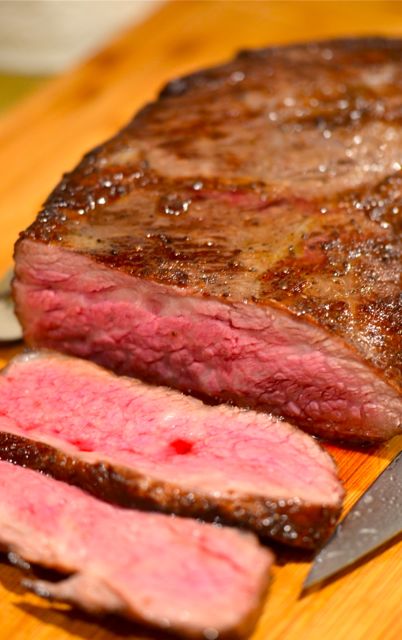
    Kobe Beef Tri-Tip Roast. A special treat.

    It may seem like sacrilege, but we don’t serve turkey at Thanksgiving. No ham either. Nope, we serve a version of our slow-roasted pork with apples and fall herbs and some kind of roast beef. If we have a big crowd, we roast a whole Tenderloin, but if we have a small crowd, we roast a Tri-Tip. And if we want to splurge, a Kobe Tri-Tip is one of our favorite roasts.

    The Tri-Tip is a triangular 2 to 2 and 1/2 pound cut of beef from the bottom sirloin primal of the cow. It has strong beefy flavor and, if cooked and sliced properly, is quite tender. Out here in California, “Santa Maria Style” Tri-tip, lightly seasoned and slowly cooked over red oak to medium-rare, is a very tasty regional specialty. And if you go into most butcher shops here in Norcal, you will find many custom Tri-Tip preparations and marinades (the black, ugly, but incredibly tasty “Fred Steak” is a local specialty). And as a special treat, most butchers feature a Kobe Tri-Tip. And this is a very special treat.
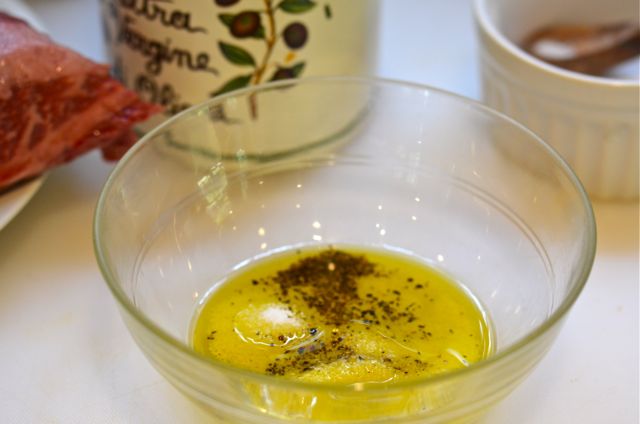
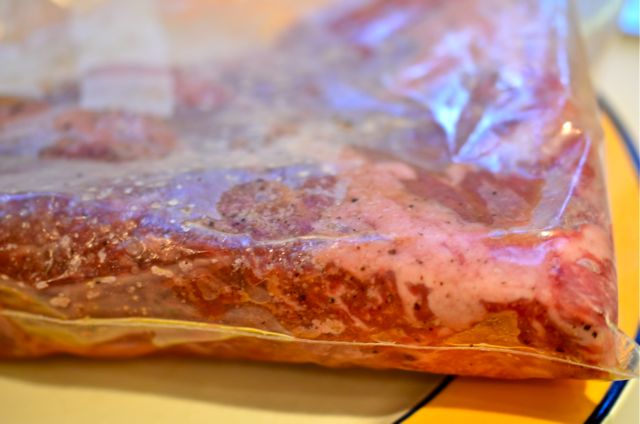
    While it’s expensive, the Kobe Tri-Tip is a great intro to Kobe beef. Kobe beef is a special type of beef with extra marbling of fat (fat is flavor) and very tender meat. Kobe is expensive, but the Tri-Tip is one of the more affordable cuts and is easy to prepare. The beefy flavor of the Tri-Tip doesn’t need much help, so we simply prepare a quick rub of olive oil, salt and pepper and let the steak marinate for at least four hours or overnight. Then you simply sear the outside of the meat for flavor and then slowly roast until the internal temperature reaches 130 to 135 degrees for medium-rare.

    We use our sous-vide machine for the Kobe Tri-Tip, as we can exactly control the internal temperature (we target 131). We then sear in a cast iron pan, slice and serve. But you can grill Tri-Tip using a two-level fire, or roast in a hot oven. We include cooking instructions for each method. The key to any Tri-Tip recipe is to avoid overcooking, so regardless of method, be sure to pull the roast from the heat before it reaches the target temperature (it will still gain five to ten degrees) and allow the roast to rest at least ten minutes before you slice and serve. And be sure to slice across the grain for a more tender bite. And now you have a very tasty roast that is the perfect size for four to six guests.
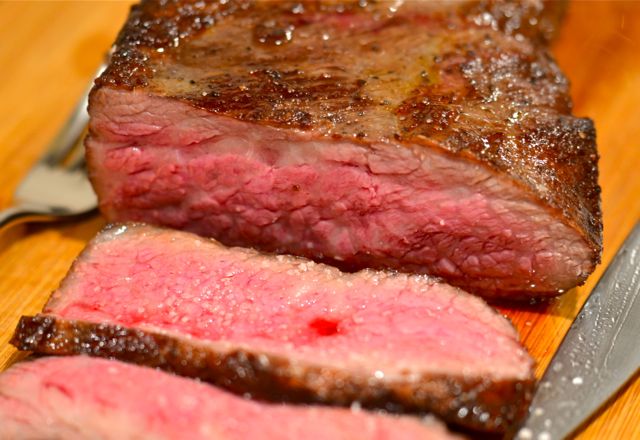
    So if you have a small group of guests for Thanksgiving, we have a suggestion. Make all the traditional sides like mashed potatoes, sweet potatoes, creamed spinach, stuffing, cranberries and pie. Pop open a good bottle of wine or cider, maybe make some punch. But save yourself a lot of time and cook up a Tri-Tip. And if you are feeling flush, try out a Kobe Tri-Tip. You won’t have to struggle with a turkey and you will have very happy guests. And if you just can’t bear the thought of beef at Thanksgiving, Tri-Tips are just as good for a casual weekend roast. Tri-Tip makes a good meal any time.

    Beef Tri-Tip Roast:

    Notes Before You Start:

    • Tri-Tip is sometimes called “triangle steak”. If you can’t find Kobe Tri-Tip, ask your butcher, it is a popular cut and usually can be ordered.
    • Tri-Tip does not have a lot of intra-muscular fat and is not a good roast to cook past medium rare. If you need to cook a roast past medium, other cuts will do better.

    What You Get: A quick, easy, tasty and tender beef roast.

    What You Need: No special equipment required. But a digital thermometer, or meat thermometer reduces the risk of overcooking. We cook this roast sous-vide, but the grill or oven also work well.

    How Long? If grilling or oven-roasting this dish takes about 20-30 minutes. Sous-vide cooking will take 4-8 hours and then 2-3 minutes of searing the meat. The beef benefits from an overnight marinade.

    Ingredients:

    (Serves 4 – 6)

    • 2 tablespoons olive oil
    • 1 tablespoon kosher salt
    • 1 teaspoon freshly ground black pepper
    • 1, 2 and 1/2 pound Tri-Tip roast, trimmed (Kobe, if you like)
    • Vegetable oil or bacon fat, for searing (if cooking sous-vide)

    Assemble:

    1. Combine the oil, salt and pepper in a small bowl and mix well. Dry off the Tri-Tip and coat with the oil mixture. Put the roast in a container or plastic bag and then place in the fridge for 4 -12 hours.
    2. If charcoal grilling: Build a two-level fire. Sear the roast for 2-3 minutes on each side, on the hot side of the grill. Then move the roast to the cooler side of the grill. Cover the grill and cook the roast, turning occasionally, until you reach an internal temperature of 125-130 degrees, about 20 minutes. Remove the roast from the heat and let it rest at least 10 minutes. Slice and serve.
    3. If gas grilling: Set up the grill for high heat. Sear the roast for 2-3 minutes on each side. Then move the heat to low, cover the grill and cook the roast, turning occasionally, until you reach an internal temperature of 125-130 degrees, about 20 minutes. Remove the roast from the heat and let it rest at least 10 minutes. Slice and serve.
    4. If oven roasting: Preheat the oven to 425. Place the roast in a roasting pan (with a rack, if possible) and put the pan in the oven. Cook for 5 minutes and then lower the heat to 350. Cook cook the roast, turning occasionally, until you reach an internal temperature of 125-130 degrees, about 20 – 30 minutes. Remove the roast from the heat and let it rest at least 10 minutes. Slice and serve.
    5. If using sous-vide: Set the sous-vide temperature to 131 degrees (or your desired temperature). Remove excess oil from the roast and seal in a vacuum bag. Cook sous-vide for at least 4 hours, 6 – 8 is preferred. When the roast is done, heat vegetable oil or bacon fat in a skillet over very high heat. Sear the roast 1 – 2 minutes on each side, or until well browned. Slice and serve.
  • Easy, “Perfect” Mashed Potatoes

    Easy, Perfect Mashed Potatoes.

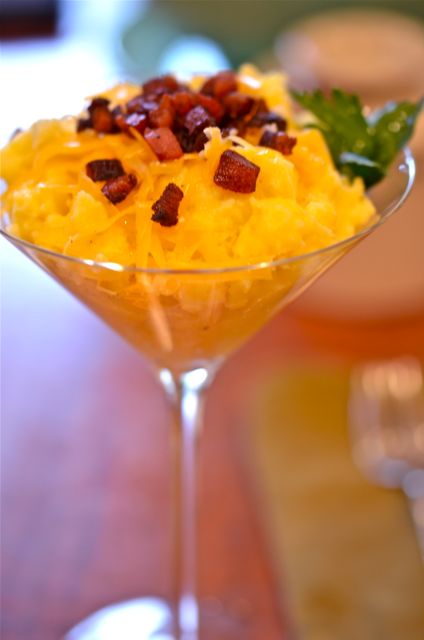
    Ah, the “Mashed Potato Martini”, the symbol of swanky 1990’s catering. A cocktail glass brimming with buttery mashed potatoes and topped with your choice of butter, sour cream, bacon, cheddar cheese, chives and parsley. A pleasant, if somewhat excessive, relic of the dot-com era. But just as the excesses of dot-com left some valuable companies and technologies in their wake, the mashed potato martini left us with a valuable legacy, we got serious about making “perfect” mashed potatoes.

    And by “perfect” we mean, tasty, easy and predictable. And a recipe that easily scales for large events. After a few years of intermittent experiments we developed this recipe / process and never looked back. The basics are simple, we use Yukon Gold potatoes and plenty of cream, butter and salt. And we have just a few techniques that make a big difference in texture. And, of course, we add a plenty of extra butter, bacon, cheese, etc. We just don’t believe in “light” or “healthy” mashers. We save that for kale dishes.

    As for the ingredients, the main difference is using Yukon Gold instead of starchy Russet potatoes. The Yukons are a mix between waxy and starchy potatoes, and they have an overt “buttery” flavor. The big advantage of the Yukons is that they don’t dry out like Russets. So while you do need cream and butter, the Yukons add their own moisture without being watery. You get a creamy texture and pronounced potato flavor to match the dairy and salt. Good stuff.

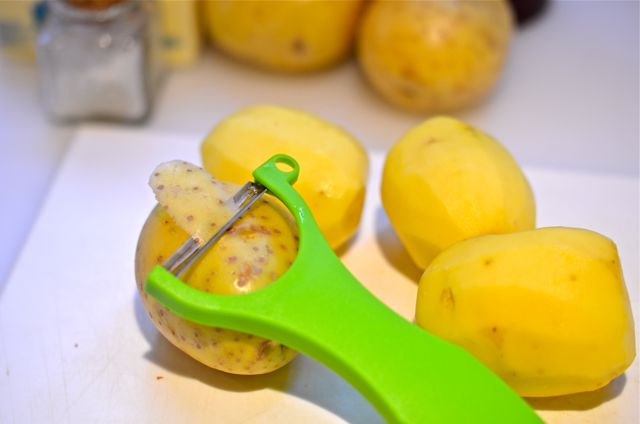
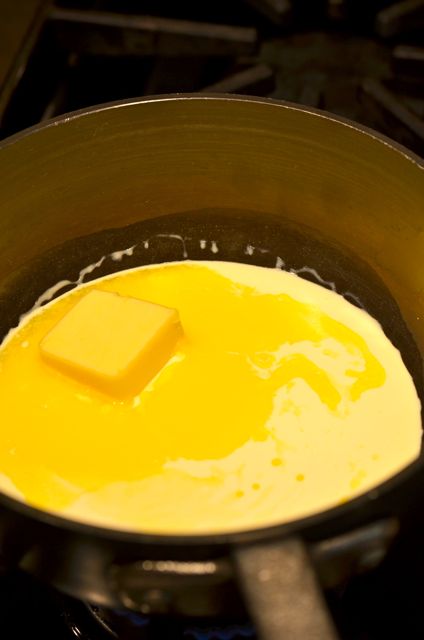
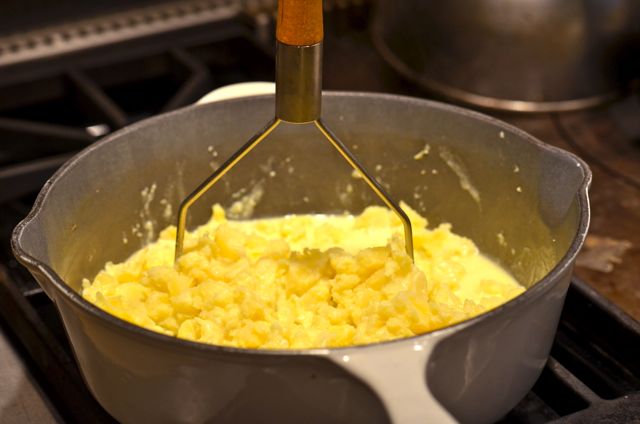
    As for the key techniques, they are also very easy, but important. Firstly, after you drain the potatoes, put them back in the hot pot and mash with the warm dairy. The hot pot dries out any extra water (you don’t want watery mashers). Secondly, only mash just enough with the masher and then move to folding with a spoon. Too much mashing makes for a gluey texture, better to have a few lumps. And finally, have extra butter and milk ready to mix into the mashers if they seem stiff or dry. And feel free to keep adding butter…hard to go wrong. Then adjust seasoning, serve with more butter on the side and you’re done. All in less than 30 minutes. Perfect.

    And if you want to be “fancy” there are a few other steps you can take. If you just hate lumps, you can run the mashers through a fine mesh strainer to get a very smooth consistency (if you do this, you may as well add as much butter as you can- like a mousseline). And lastly, if you want to pull out the martini glasses and add a bunch of garnishes you may get a few extra smiles at the table. A slightly ridiculous, but also delicious, dish for the “holidaze”.

    Easy, Perfect Mashed Potatoes

    Notes Before You Start:

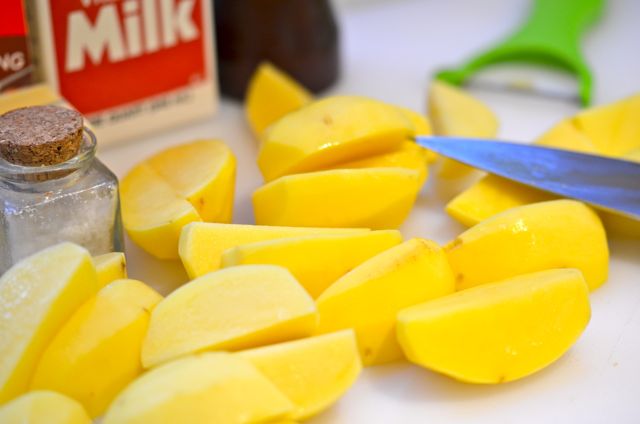
    • Yukon Gold potatoes are widely available. Use the largest Yukons you can to save time on peeling.
    • This recipe is for 4 – 6 as a side, but scales easily for larger groups.

    What You Get: Like we said, perfect mashed potatoes.

    What You Need: A potato masher, or a ricer. But the masher is the best tool for this recipe.

    How Long? About 30 minutes, with 10 minutes of active time. This is an anytime dish. Continue reading

  • Weekly Cocktail #36: A Martini

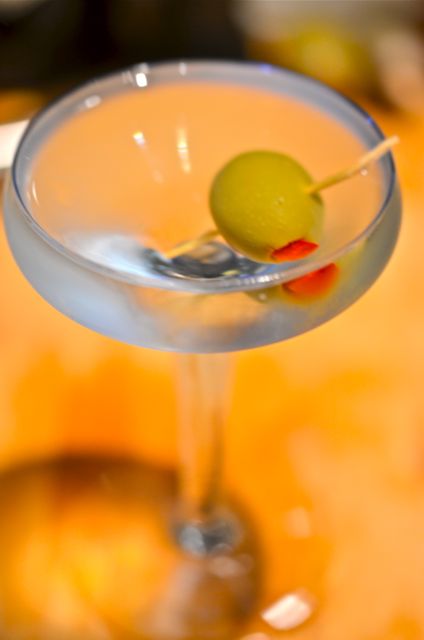
    A Martini.

    Writers coin hundreds, perhaps thousands, of words each day to wax over the history and debate the composition of this week’s cocktail, the Martini. We can’t, and won’t, try to match any of it. What we will say is that the weather is getting nippy, we are cooking richer dishes and many holiday parties are on the horizon. Our tastes tend to shift with the season, and these days we start to crave the occasional Martini. Regardless of all the blather endless conversation, a good Martini is still a delight. Clean, cold and elegant, and with crisp, bracing flavors, a Martini is a good start to a special evening. (A few more can also be a very poor end to an evening, but we will leave that to Dorothy Parker).

    Ironically, for all the “best”, “only way”, or “classic” interpretations of the Martini, the recipe has been in flux throughout the Martini’s history. The only real constants are gin (yes, only gin) and vermouth. And that’s it, otherwise the variables are endless. Early recipes used Old Tom gin and sweet vermouth, some Plymouth gin and a mix of sweet and dry vermouth, later recipes London dry gin and dry vermouth. And the ratios are simply all over the place. Even the best cocktail books and writers simply don’t agree. Some recipes go 50/50 vermouth to dry gin (most recipes these days use dry gin) and some still use just the lightest hint of vermouth, others include a dash of bitters. And, of course, you have the preparation and garnish. The amount of back-and-forth over shaken vs. stirred and olive vs. a lemon twist already fill a few volumes. In fact, the one thing we can say with confidence is that if someone tells you they know the “best” or “only” way to make a Martini, they really don’t know what they are talking about. All they really know is how they like “their” Martini. If you like a good Martini, you need to try a number of variations and decide what you like. This is a good thing.

    And while you experiment, we do suggest you consider a few things. Firstly, vermouth isn’t an afterthought. There are many quality vermouths out there from the inexpensive (Noilly-Pratt) to the premium (Dolin). And if you keep them in the fridge they actually taste good. No need to skimp. Try recipes that use more vermouth, you may be surprised. Secondly, the world of gin is exploding with multiple flavor profiles. Good London dry gin and Plymouth are still heavy on juniper, but “new world” gins like Hendrick’s and Nolet’s focus on flavors like cucumber or rose petals (we tend to like the old standby of Tanqueray and the occasional dalliance with Hendrick’s, but that’s just us). Third, we suggest you play around on the edges, try a dash of orange bitters, experiment with olives and twists depending on the gin or vermouth you use.  Finally, it makes sense to keep your Martinis small so they don’t warm up, a cold Martini is a good martini. And feel free to shake or stir, just be sure to do it until the Martini is very, very cold.

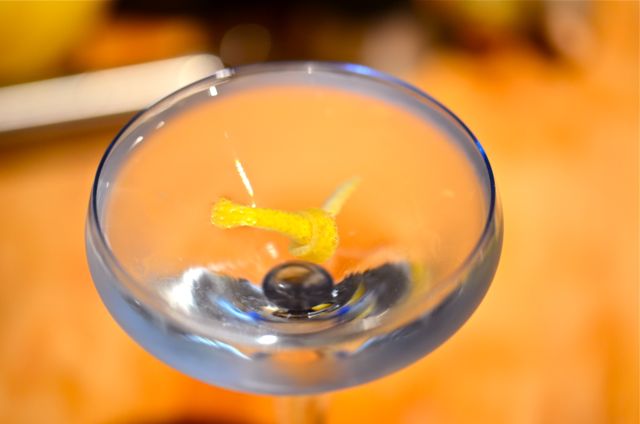
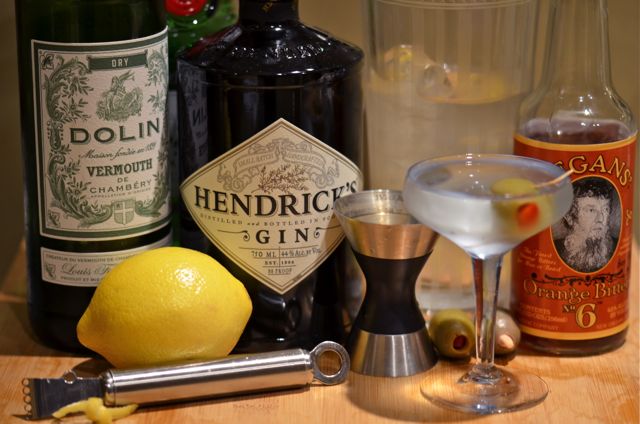
    Right now, we enjoy Dolin dry vermouth and have it highlight our Martinis. We use a decent slug of vermouth with dry gin and we also enjoy an “old-school” variation and include some orange bitters. As for olives or a twist, it depends on our mood and if we need a quick appetizer, but we like the lemon oil from the twist. So our current recipe is 1 and 1/2 oz. dry gin, 3/4 oz. dry vermouth, a dash of Regan’s Orange Bitters #6 and a lemon twist. We have a cool mixing glass, so we stir. But do what you like. Enjoy yourself.

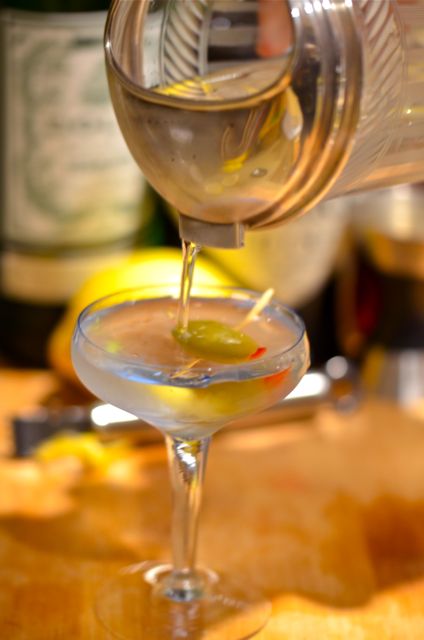
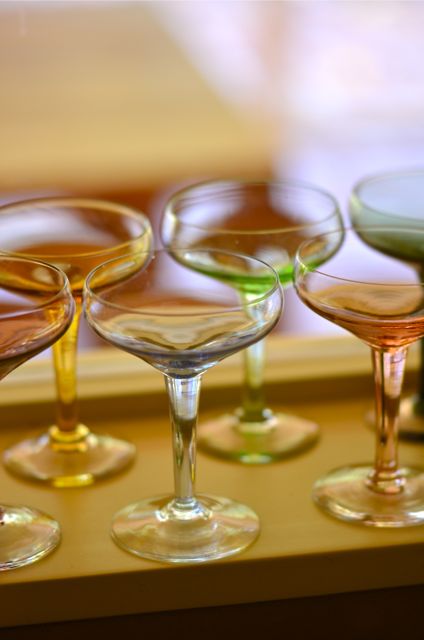
    And one last note. Few cocktails match the spare, timeless elegance of the martini. The shaker, the glass, the olive all look beautiful and harken back to the art-deco designs and speakeasies of the 1920’s. Having a Martini is a special event, a small step back in time, an escape. And we celebrate that. However you make it, take the time to make your Martini well. Pull out some of your best glasses and maybe even a silver tray. Pick out some good music to play. Maybe invite over a few good friends. Serve your Martini with style, it will pay you back handsomely.

    The Martini:

    Ingredients:

    • 1 and 1/2 oz. dry gin
    • 3/4 oz. good dry vermouth
    • 1 dash Regan’s Orange Bitters #6 (optional)
    • Lemon twist

    Assemble:

    1. Combine the gin, vermouth and bitters in a mixing glass with ice. Stir until very cold and strain into a chilled cocktail glass or coupé. Squeeze the twist over the drink and then place it in the glass. Serve.
  • Braised Short Ribs

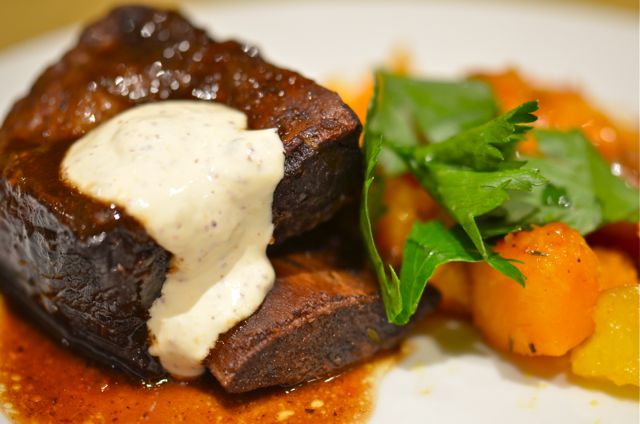
    Braised Short Ribs with horseradish sauce.

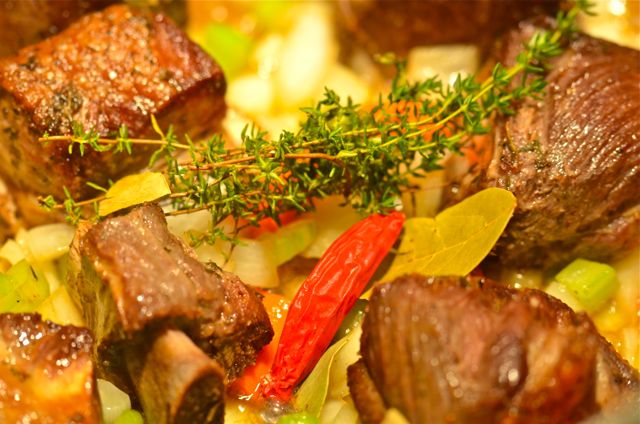
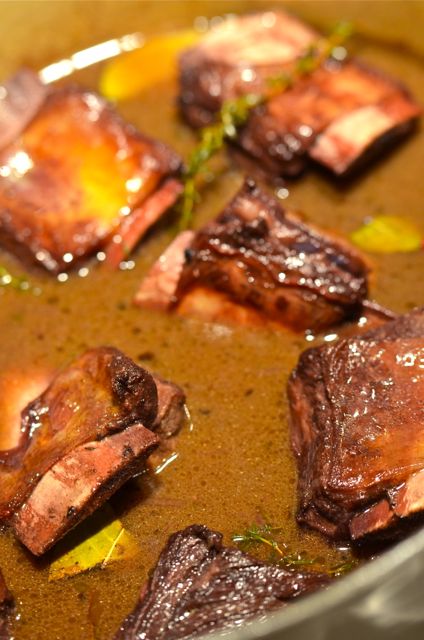
    Typical of California this time of year, in one day we went from eighty degrees and sunny to forty-five degrees and rainy, with snow in the higher hills. And while the rain does turn the golden hills back to green, we will still take the warmer weather as long as we can get it. But one of the benefits of colder weather is that we get to make some more “wintry” dishes, and that often means braises and stews. And one of our favorite braises involves beef short ribs.

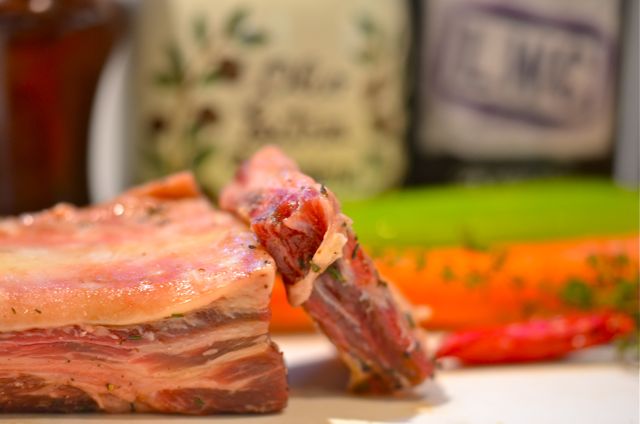
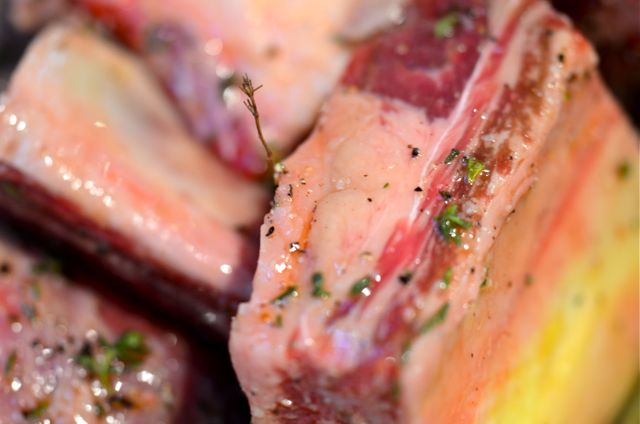
    Short ribs are a cheap, flavorful and tender (if you cook them right) cut of beef from the rib/plate section of the cow. Short ribs are butchered a few different ways, but for braises the rectangular “English” cut is usually preferred. The longer, thinner “flanken” or “accordion” cuts are more commonly used in Korean-style preparations, which are fantastic, but for another post. The short rib pieces are anywhere from 1-3 inches across and 1-2 inches thick and will usually contain a section of the rib bone. As there is a lot of fat and connective tissue (along with a bone), the short rib has potential for a lot of flavor, but is likely to be tough unless cooked long enough, at moderate temperatures and in a moist environment. Sounds like a braise is in order.

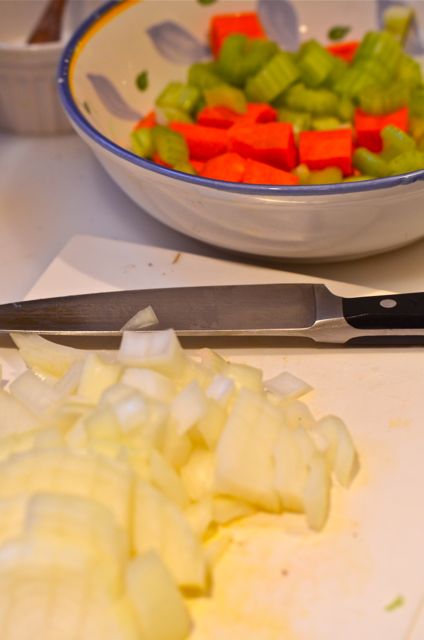
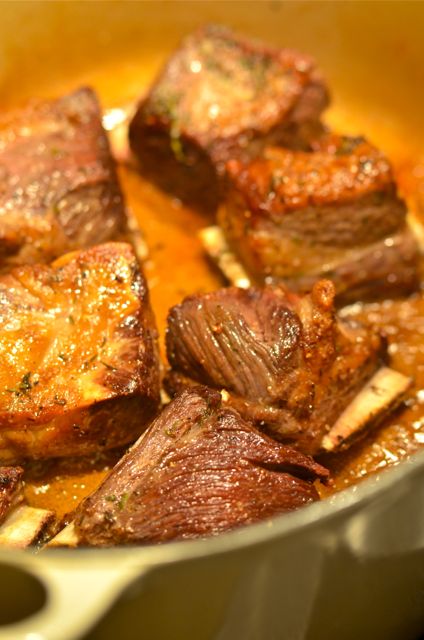
    Braising is a combination cooking method where meat is first browned in dry, high heat and then slowly cooked in a covered pot along with liquid. And if you just said “isn’t that just like a pot roast”, you are correct. The high heat provides tasty, browned flavors and texture, while the moderate temperature, moist cooking breaks down tough cuts of meat and builds a sauce. The addition of aromatics and herbs and flavored liquids like wine and/or stock make for very deep, rich flavors. And while braising takes time and has a few steps, it is an easy cooking method and has the bonus that most braises keep well and are often better the second day. If you cook for a hungry family or a crowd, braises should be in your toolkit. (It is worth noting that braised short ribs are a popular dish with caterers for all the reasons we just noted, delicious, low-cost and easy to prepare ahead of time.)

    Continue reading

  • Cocktail DIY: Stocking Your Bar At Home

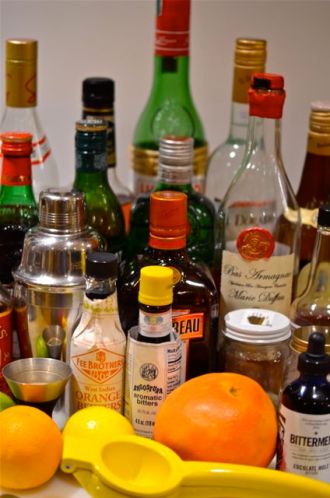
    As we continue our exploration of cocktails, we are often asked “how do you get started at home and what should we buy”? We certainly have our opinions and we will share them, but there are no perfect answers (opinions, comments, disagreements and even outrage are welcome, feel free to share your thoughts!).  But here is how we would get started:

    “Short and sweet” version of the home bar.

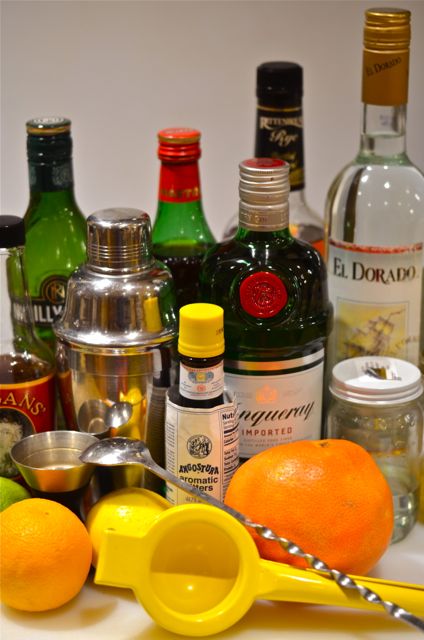
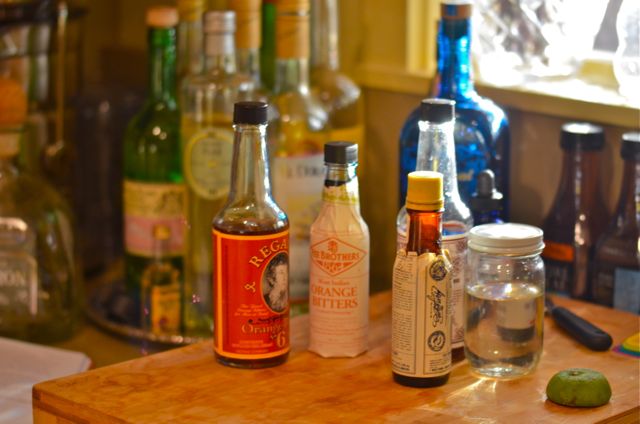
    Here is the “short and sweet” version: Get a bottle of dry gin, a bottle of light rum and a bottle of whiskey (we like rye, but bourbon or Canadian whiskey are good). Get some Angostura and Regan’s Orange bitters, sweet and dry vermouth (nothing fancy) and fresh citrus. Make a few basic syrups with sugar and honey. Get that old cocktail shaker off the shelf (we bet you have one somewhere) and start making drinks. And what can you make? Martinis, Manhattans, Old Fashioneds, Sours and Daiquiris along with dozens of other “classic” cocktails. Go to Cocktail DB to get more ideas based on ingredients in your fridge. You are off and running for about $100 bucks, and if you assume you will get at least 50 cocktails from these three bottles, the average cost per drink is about $2. Not too shabby (to borrow from Adam Sandler).

    But what if you want to take it up a notch? For about $250 you can stock a home bar that allows you to build literally hundreds of cocktails and with “professional” results. A few more spirits and bitters, a liqueur or two and a bit of extra gear and you have a “pro” bar at home. So here is the breakdown, with a focus on readily (and nationally) available ingredients:

    Spirits:

    • Dry Gin: All sorts of good options here, but stalwarts like Tanqueray, Brokers, Gordon’s and Beefeater are all under $20. If you are a gin fan, there are dozens of good artisan gins to try, usually around $30. And if you just can’t stand juniper, “new world” gins like Hendrick’s (cucumber) and Nolet (floral) focus on other flavors and are good options. Martinis, Rickeys, Gimlets, Sours and Collins’ are all based on gin. Try classics like the Pegu Club or Aviation.
    • Whiskey: We like rye whiskey and suggest Rittenhouse 80 proof for about $20. If you like bourbon, Bulleit at $25 is a good choice, but there are good options around $15. Good for Manhattans, Old Fashioneds and Sours. Try the Daisy Black for a twist on a Whiskey Sour.
    • Light Rum: We suggest El Dorado Light Demerara rum at $15. Great rum at a good price (their Gold rum is also excellent). Bacardi and Brugal are also solid choices. Good for classics like Daiquiris and Cuba Libre, also a component of many tiki drinks.
    • Aged / Dark Rum:  We suggest Barbancourt 4 or 8-year-old and/or Appleton aged rums, about $25 – $30. While very different, both offer the deep, funky sugar and vanilla flavors that make tiki / tropical drinks sing. Great for tiki drinks and for deeper versions of Daiquiris.
    • Tequila: Plenty of good blanco tequilas under $20, just be sure it is 100% agave. We like to use richer-flavored reposado tequila in most drinks and prefer Cazadores, it works in just about everything and is about $25. For most, tequila is still all about Margaritas, but let’s face it, Margaritas still rock. If you are looking to branch-out, try the Ernesto or Chica Facil.
    • Brandy: This is a tough one. Good brandy isn’t cheap and some brands are not widely available. You will need help at your liquor store. VS Cognac is ok, but XO or VSOP will be better but cost over $30. We like Armagnac, and you can get a very good bottle for $30- $35. National brands like Hennessy have VS Cognacs for under $30, domestic brandies will often be less expensive. If you want to make a good Sidecar, you need good brandy. Also, a key ingredient in classic punches, like Chatham Artillery Punch.
    • Vodka: While not a favorite of many cocktail enthusiasts, a lot of people like vodka, and you probably have a bottle somewhere in the house already. Plenty of good options under $20. Cosmopolitans and Lemondrops are good reasons to have some vodka in your bar.
    • Extras: If you want to add-on, blended Scotch, Irish whiskey, Genever (gin in a richer, maltier style), Laird’s Bonded Applejack (apple brandy), Cachaca (Brazilian sugar cane spirit) and Rhum Agricole are all worthy additions to your bar. Continue reading
  • Weekly Cocktail #34: The Sawyer

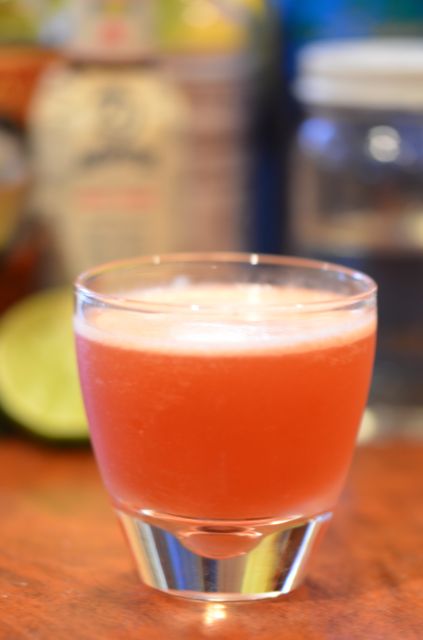
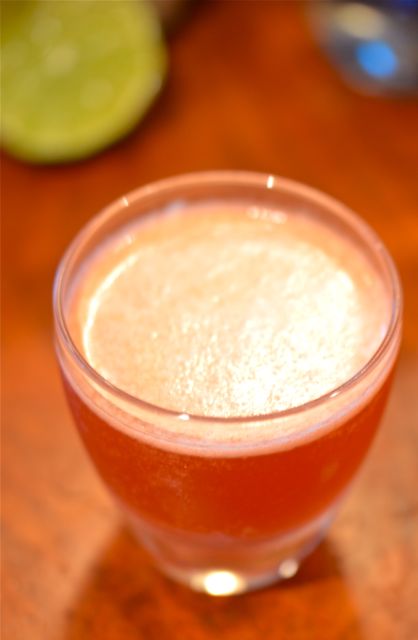
    The Sawyer.

    With the Giants in the World Series and us trying to pick up the kids, get them to the game (doing homework in the car the whole way) and then drive back, it has been a tough week for cocktails around the farm. Not that we mind (Go Giants!). We do get to sneak in a beer now and then (thankfully they have decent beer and pretzels at the ballpark). But we still got to play a bit with cocktails and our focus drifted to using more bitters.

    We have been enjoying bitters in sparkling cocktails like the Seelbach and Rochelle-Normande, and started to look for more “bitters-heavy” cocktails to try. And if playing with bitters, then one of the better sources for recipes is Brad Thomas Parson’s cocktail book “Bitters, A Spirited History of a Classic Cure-All“. The book has lot’s of history and data on bitters and dozens of classic and new recipes to try. We “sampled” most of the classics, with the Pegu Club being our favorite, so we drifted toward the more modern cocktails.

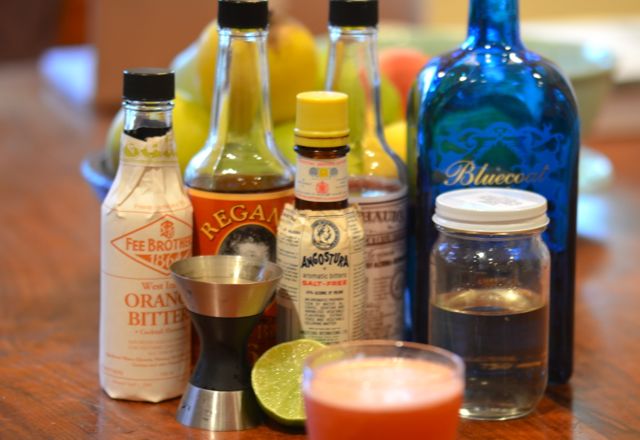
    And it didn’t take long for us to find the Sawyer. The Sawyer combines gin, sugar and lime with a full blast of over 25 dashes of bitters. It’s basically a gimlet with an almost radioactive amount of bitters. But we like gin and lime, so we are always happy to see riffs on the theme. In this case, the Sawyer has 14 dashes of Angostura, 7 of Peychaud’s and 7 of orange bitters (Regan’s #6 and/or Fee’s West Indian). And not only does the drink taste great with layers of spice, cherry, anise and orange, over a core of juniper and lime, but this recipe pretty much represents the “core” bitters you should have in a bar at home (we have more, but we’re geeky that way). And bitters usually cost anywhere from $5 -$15 bucks and last forever, so they are a worthwhile purchase. So here is a bit of info on the bitters:

    • Angostura: The #1 bitters you need in your bar. Many classic and tiki drinks use it and many recipes sub Angostura if you don’t have more exotic bitters handy. Angostura is dark, bitter and spicy with cinnamon and tamarind flavor. It adds a detectable “zing” to most drinks and a bit of a tannic finish.
    • Orange Bitters: After Angostura, orange bitters are the most common, particularly in classic cocktails. Regan’s #6 has deep, spicy orange peel flavors while Fee’s West Indian bitters have brighter, fresher citrus notes.
    • Peychaud’s: Is the bitters of New Orléans and the key to a good Sazerac and many other classic, whiskey-based cocktails. Peychaud’s has pronounced cherry and anise flavor.

    The other cool thing about the Sawyer is that is comes from Momofuku Ssam Bar in NYC, one of our favorite places. In typical fashion, Don Lee the bartender created it and named it after the daughter of Wylie Dufresne, another famous NYC Chef. Got all that? This is all sort of “inside baseball”, but the Sawyer is a very tasty drink and features layered, spicy flavors and aromas while still managing to be light and refreshing. A very pleasant surprise, and a good excuse to go get some bitters.

    The Sawyer:

    (From Brad Thomas Parsons and Don Lee)

    Ingredients:

    • 2 oz. dry gin
    • 1/2 fresh lime juice
    • 1/2 oz. simple syrup
    • 14 dashes Angostura bitters
    • 7 dashes Peychaud’s bitters
    • 7 dashes orange bitters (split of Regan’s #6 and Fees West Indian Orange bitters, if you can)

    Assemble:

    1. Combine all the ingredients in a cocktail shaker with ice. Shake thoroughly and strain into a chilled old-fashioned glass, cocktail glass or coupé.