• Weekly Cocktail #38: The Rusty Nail

    nail1

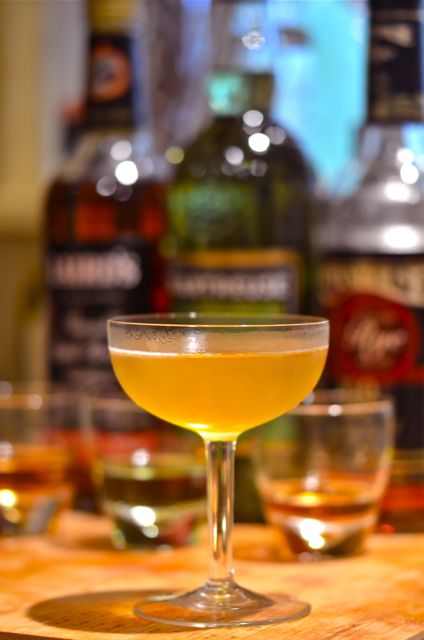
    The Rusty Nail. Up.

    The rain is coming down in sheets, the wind is howling and it’s cold (at least for the Bay Area). Time to light a fire, relax, play some cards or read a good book. But what cocktail to have? This would be a good time for a toddy or old fashioned, maybe a Manhattan. But this is also a perfect time to break out that bottle of Drambuie gathering dust in the back of your bar, grab some blended Scotch and make the almost-forgotten classic, the Rusty Nail.
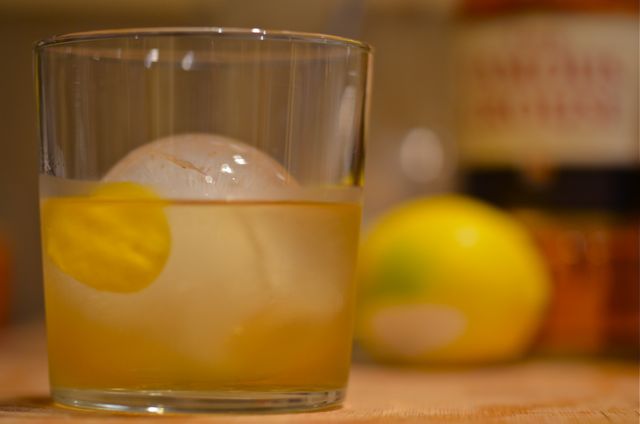
    nail4

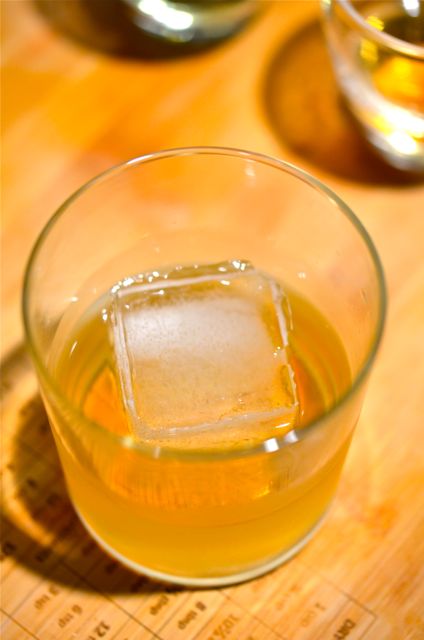
    The Rusty Nail. On the rocks.

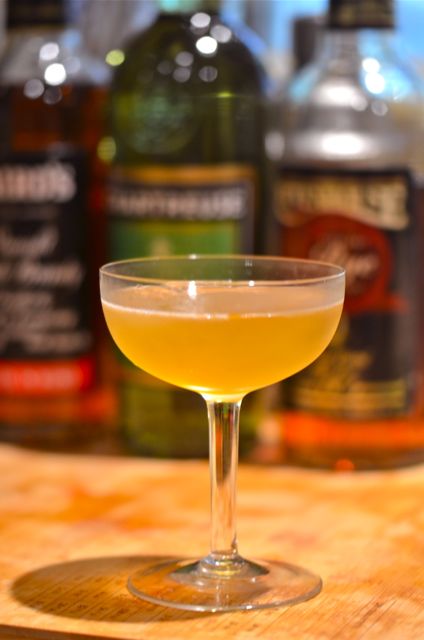
    The Rusty Nail combines blended Scotch, Drambuie and (sometimes) a lemon twist. It it one of the easiest cocktails to make and is served up or on the rocks. The only issue with the Rusty Nail is getting the Drambuie if you don’t already have some hiding away. Drambuie is one of the few Scotch-based liqueurs and it tastes like sweetened Scotch with notes of honey, heather, citrus and spice. Drambuie doesn’t always play well with other spirits, but it does go well with Scotch. The honey and citrus soften the hard, smokey edges of Scotch and make it sippable. To some degree, in the Rusty Nail the Drambuie modifies the Scotch in a similar way to dry vermouth with gin in the Martini, or sweet vermouth with whiskey in a Manhattan. The base spirit still leads the drink, but no longer punches you in the face. Kinder, gentler booze.
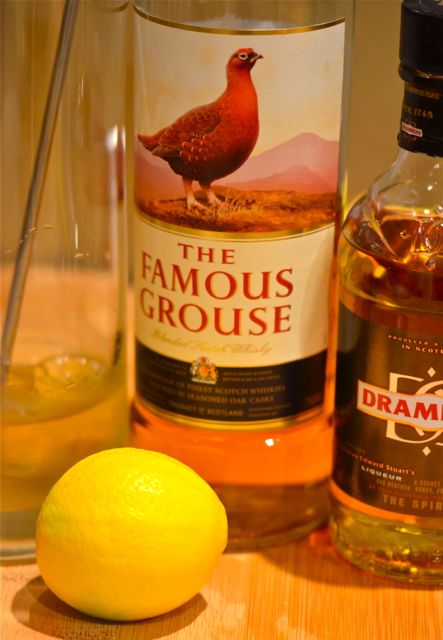
    nail5As noted, the Rusty Nail is very easy to make. The only question is the ratios. Some recipes suggest equal portions of blended Scotch and Drambuie, some 2 to 1 and some 4 to 1. We like a 4 to 1, but it will depend on your tastes and the Scotch you use. The cool thing is that you can just add more Scotch or Drambuie as needed. Some recipes also suggest using a single-malt Scotch for the Rusty Nail, and while it’s very good, we will save our single-malts to serve on their own or in toddies. And finally, some recipes use a lemon twist, some don’t. We like a touch of citrus in most drinks and this is no exception. The aroma of the lemon with the Scotch adds an extra dimension.
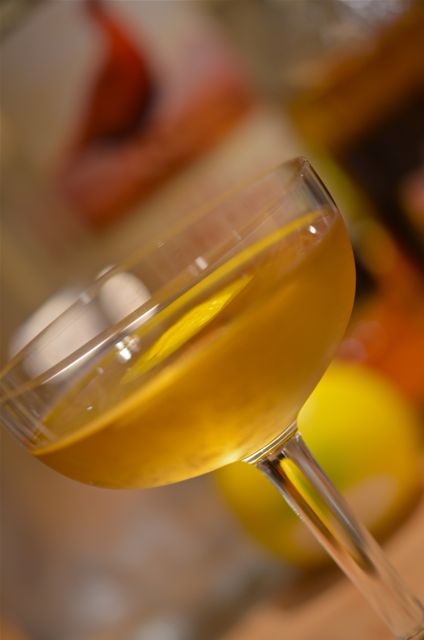
    nail2And then you have the history of the Rusty Nail. As Drambuie is only about 100 years old, the Rusty Nail is a somewhat recent creation. Drambuie and Scotch cocktails started showing up in the 1930s with various names. Cocktail historian David Wondrich mentions several names for this drink including the “B.I.F.” and, even better, the “Knucklehead”. We kind of like Knucklehead (having sometimes behaved like one). But, not surprisingly, the marketing folks at Drambuie backed the “Rusty Nail” and the name stuck. And the Rusty Nail was a very popular cocktail from the 1950s to the 1970s, but then its popularity faded as darker spirits lost favor.
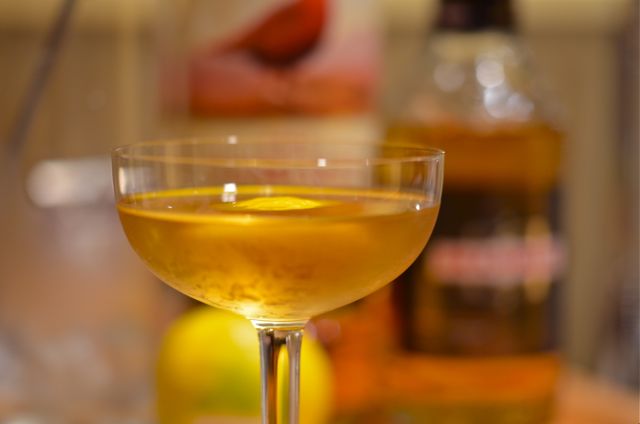
    nailNowadays the Rusty Nail is having something of a comeback. Craft and classic cocktail bars are serving the Rusty Nail (or variations) and Drambuie started to market itself, and its classic cocktail, to new audiences. Drambuie still isn’t cheap, but if you like whiskey, particularly Scotch, it is worth finding. And if you are looking for a strong, sweet and boozy (but not too boozy) sip, the Rusty Nail is a very good choice and a welcome diversion from old fashioneds and Manhattans.

    The Rusty Nail:

    Ingredients:

    • 2 oz. blended Scotch (the Famous Grouse)
    • 1/2 oz. Drambuie
    • Lemon twist

    Assemble:

    1. Add the Scotch and Drambuie to a cocktail glass with some ice. Stir until well chilled and strain into an old fashioned glass with ice, or strain into a chilled cocktail glass or coupé. Twist the lemon peel over the drink, add the peel to the cocktail and serve.
  • Weekly Cocktail #36: A Martini

    A Martini.

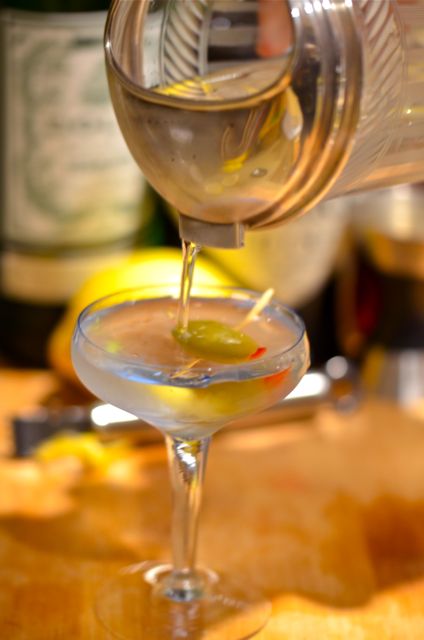
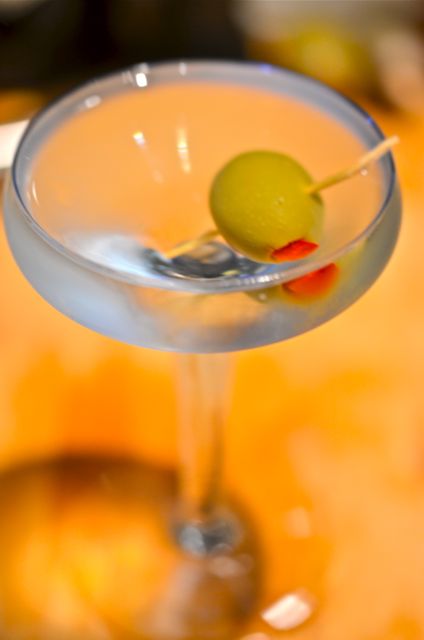
    Writers coin hundreds, perhaps thousands, of words each day to wax over the history and debate the composition of this week’s cocktail, the Martini. We can’t, and won’t, try to match any of it. What we will say is that the weather is getting nippy, we are cooking richer dishes and many holiday parties are on the horizon. Our tastes tend to shift with the season, and these days we start to crave the occasional Martini. Regardless of all the blather endless conversation, a good Martini is still a delight. Clean, cold and elegant, and with crisp, bracing flavors, a Martini is a good start to a special evening. (A few more can also be a very poor end to an evening, but we will leave that to Dorothy Parker).

    Ironically, for all the “best”, “only way”, or “classic” interpretations of the Martini, the recipe has been in flux throughout the Martini’s history. The only real constants are gin (yes, only gin) and vermouth. And that’s it, otherwise the variables are endless. Early recipes used Old Tom gin and sweet vermouth, some Plymouth gin and a mix of sweet and dry vermouth, later recipes London dry gin and dry vermouth. And the ratios are simply all over the place. Even the best cocktail books and writers simply don’t agree. Some recipes go 50/50 vermouth to dry gin (most recipes these days use dry gin) and some still use just the lightest hint of vermouth, others include a dash of bitters. And, of course, you have the preparation and garnish. The amount of back-and-forth over shaken vs. stirred and olive vs. a lemon twist already fill a few volumes. In fact, the one thing we can say with confidence is that if someone tells you they know the “best” or “only” way to make a Martini, they really don’t know what they are talking about. All they really know is how they like “their” Martini. If you like a good Martini, you need to try a number of variations and decide what you like. This is a good thing.

    And while you experiment, we do suggest you consider a few things. Firstly, vermouth isn’t an afterthought. There are many quality vermouths out there from the inexpensive (Noilly-Pratt) to the premium (Dolin). And if you keep them in the fridge they actually taste good. No need to skimp. Try recipes that use more vermouth, you may be surprised. Secondly, the world of gin is exploding with multiple flavor profiles. Good London dry gin and Plymouth are still heavy on juniper, but “new world” gins like Hendrick’s and Nolet’s focus on flavors like cucumber or rose petals (we tend to like the old standby of Tanqueray and the occasional dalliance with Hendrick’s, but that’s just us). Third, we suggest you play around on the edges, try a dash of orange bitters, experiment with olives and twists depending on the gin or vermouth you use.  Finally, it makes sense to keep your Martinis small so they don’t warm up, a cold Martini is a good martini. And feel free to shake or stir, just be sure to do it until the Martini is very, very cold.

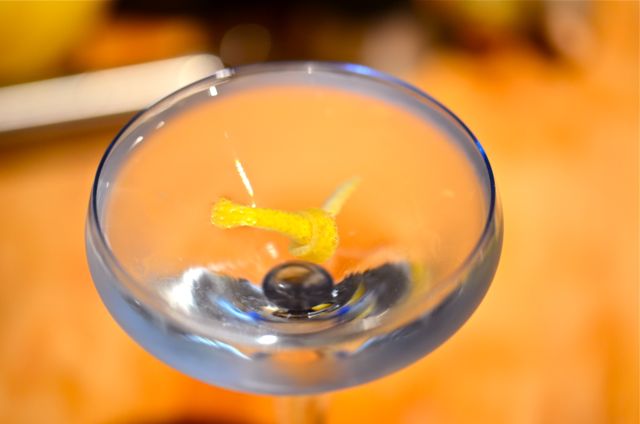
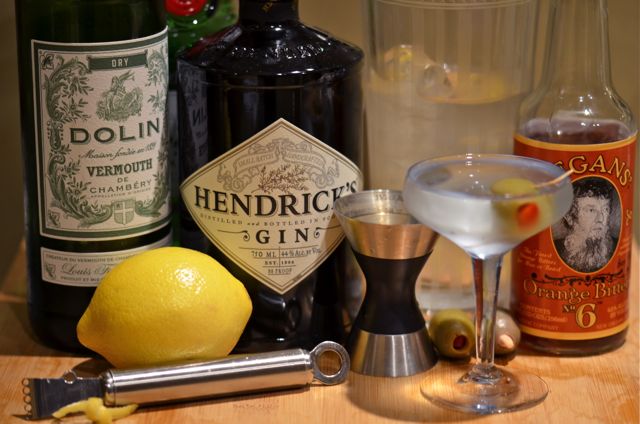
    Right now, we enjoy Dolin dry vermouth and have it highlight our Martinis. We use a decent slug of vermouth with dry gin and we also enjoy an “old-school” variation and include some orange bitters. As for olives or a twist, it depends on our mood and if we need a quick appetizer, but we like the lemon oil from the twist. So our current recipe is 1 and 1/2 oz. dry gin, 3/4 oz. dry vermouth, a dash of Regan’s Orange Bitters #6 and a lemon twist. We have a cool mixing glass, so we stir. But do what you like. Enjoy yourself.

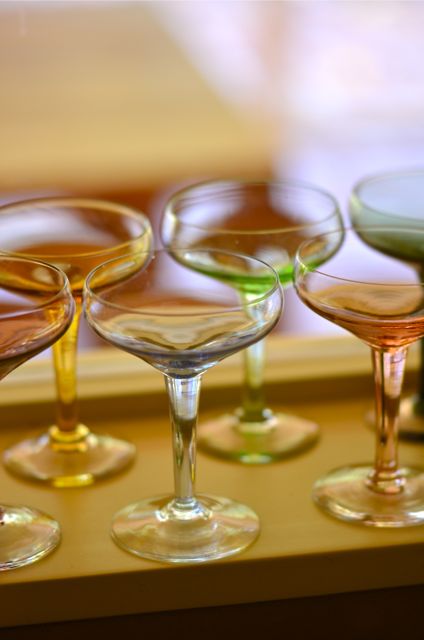
    And one last note. Few cocktails match the spare, timeless elegance of the martini. The shaker, the glass, the olive all look beautiful and harken back to the art-deco designs and speakeasies of the 1920’s. Having a Martini is a special event, a small step back in time, an escape. And we celebrate that. However you make it, take the time to make your Martini well. Pull out some of your best glasses and maybe even a silver tray. Pick out some good music to play. Maybe invite over a few good friends. Serve your Martini with style, it will pay you back handsomely.

    The Martini:

    Ingredients:

    • 1 and 1/2 oz. dry gin
    • 3/4 oz. good dry vermouth
    • 1 dash Regan’s Orange Bitters #6 (optional)
    • Lemon twist

    Assemble:

    1. Combine the gin, vermouth and bitters in a mixing glass with ice. Stir until very cold and strain into a chilled cocktail glass or coupé. Squeeze the twist over the drink and then place it in the glass. Serve.
  • Cocktail DIY: Stocking Your Bar At Home

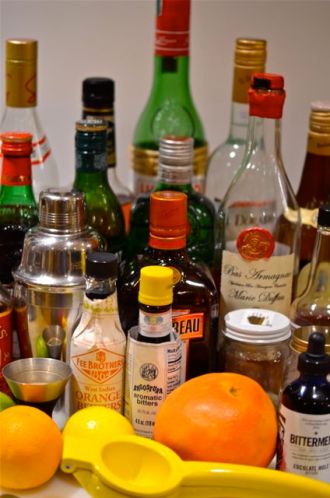
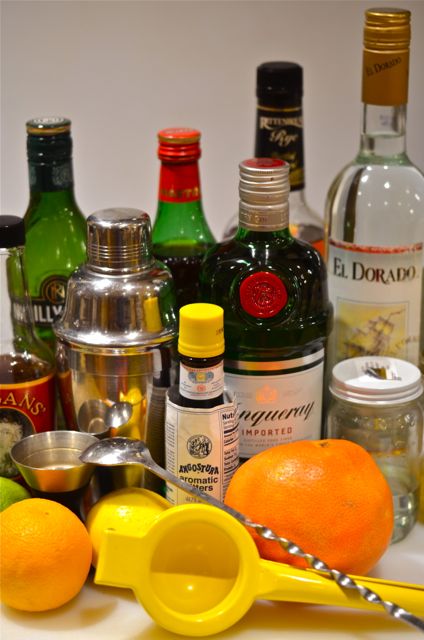
    As we continue our exploration of cocktails, we are often asked “how do you get started at home and what should we buy”? We certainly have our opinions and we will share them, but there are no perfect answers (opinions, comments, disagreements and even outrage are welcome, feel free to share your thoughts!).  But here is how we would get started:

    “Short and sweet” version of the home bar.

    Here is the “short and sweet” version: Get a bottle of dry gin, a bottle of light rum and a bottle of whiskey (we like rye, but bourbon or Canadian whiskey are good). Get some Angostura and Regan’s Orange bitters, sweet and dry vermouth (nothing fancy) and fresh citrus. Make a few basic syrups with sugar and honey. Get that old cocktail shaker off the shelf (we bet you have one somewhere) and start making drinks. And what can you make? Martinis, Manhattans, Old Fashioneds, Sours and Daiquiris along with dozens of other “classic” cocktails. Go to Cocktail DB to get more ideas based on ingredients in your fridge. You are off and running for about $100 bucks, and if you assume you will get at least 50 cocktails from these three bottles, the average cost per drink is about $2. Not too shabby (to borrow from Adam Sandler).

    But what if you want to take it up a notch? For about $250 you can stock a home bar that allows you to build literally hundreds of cocktails and with “professional” results. A few more spirits and bitters, a liqueur or two and a bit of extra gear and you have a “pro” bar at home. So here is the breakdown, with a focus on readily (and nationally) available ingredients:

    Spirits:

    • Dry Gin: All sorts of good options here, but stalwarts like Tanqueray, Brokers, Gordon’s and Beefeater are all under $20. If you are a gin fan, there are dozens of good artisan gins to try, usually around $30. And if you just can’t stand juniper, “new world” gins like Hendrick’s (cucumber) and Nolet (floral) focus on other flavors and are good options. Martinis, Rickeys, Gimlets, Sours and Collins’ are all based on gin. Try classics like the Pegu Club or Aviation.
    • Whiskey: We like rye whiskey and suggest Rittenhouse 80 proof for about $20. If you like bourbon, Bulleit at $25 is a good choice, but there are good options around $15. Good for Manhattans, Old Fashioneds and Sours. Try the Daisy Black for a twist on a Whiskey Sour.
    • Light Rum: We suggest El Dorado Light Demerara rum at $15. Great rum at a good price (their Gold rum is also excellent). Bacardi and Brugal are also solid choices. Good for classics like Daiquiris and Cuba Libre, also a component of many tiki drinks.
    • Aged / Dark Rum:  We suggest Barbancourt 4 or 8-year-old and/or Appleton aged rums, about $25 – $30. While very different, both offer the deep, funky sugar and vanilla flavors that make tiki / tropical drinks sing. Great for tiki drinks and for deeper versions of Daiquiris.
    • Tequila: Plenty of good blanco tequilas under $20, just be sure it is 100% agave. We like to use richer-flavored reposado tequila in most drinks and prefer Cazadores, it works in just about everything and is about $25. For most, tequila is still all about Margaritas, but let’s face it, Margaritas still rock. If you are looking to branch-out, try the Ernesto or Chica Facil.
    • Brandy: This is a tough one. Good brandy isn’t cheap and some brands are not widely available. You will need help at your liquor store. VS Cognac is ok, but XO or VSOP will be better but cost over $30. We like Armagnac, and you can get a very good bottle for $30- $35. National brands like Hennessy have VS Cognacs for under $30, domestic brandies will often be less expensive. If you want to make a good Sidecar, you need good brandy. Also, a key ingredient in classic punches, like Chatham Artillery Punch.
    • Vodka: While not a favorite of many cocktail enthusiasts, a lot of people like vodka, and you probably have a bottle somewhere in the house already. Plenty of good options under $20. Cosmopolitans and Lemondrops are good reasons to have some vodka in your bar.
    • Extras: If you want to add-on, blended Scotch, Irish whiskey, Genever (gin in a richer, maltier style), Laird’s Bonded Applejack (apple brandy), Cachaca (Brazilian sugar cane spirit) and Rhum Agricole are all worthy additions to your bar. Continue reading
  • Weekly Cocktail #33: The Rochelle-Normande

    The Rochelle-Normand Cocktail

    As we drink our way through the seasons (and yes, that sounds both good and bad) we find some cocktail ingredients are easier to work with than others. Citrus is easy, lots of great recipes and combinations. Stone fruits are harder to handle, but are very tasty in all sorts of drinks. Apples? No problem. But now we get to pears, and it gets a bit challenging.

    Pears are one of our most ancient fruits and are popular all over the world, but oddly, are not a common cocktail ingredient. Pears have a soft, sweet flavor and light fragrance that can get lost when mixed with other flavors. And pear brandy (eau-de-vie), while common in France, is a rarity here in the states. More recently new pear liqueurs and vodkas hit the market. And since it is pear season (and we have a few pear trees and a decent crop) we got some Rothman & Winter Orchard Pear liqueur and started to experiment.

    As we noted, there are few “classic” pear cocktails to work from, so we approached this more like a dessert recipe. Firstly, we tasted the pear liqueur and it was sweet with clear pear flavor and a slightly dry finish. A good sip, but more of an attractive flavor accent than a lead note. So what else plays well with pears? Apple and spice came to mind. And we also like sparkling cocktails, as they often show off the aromas of their ingredients (and we had some sparkling wine left over from making Death in the Afternoon cocktails). With that in mind we did some research and found a cocktail called the Daisy Buchanon that combines pear liqueur, apple brandy and Champagne. We then looked to another of our favorite sparklers, the bitters-heavy, spicy Seelbach, for inspiration. And after many experiments, we got the Rochelle-Normande.

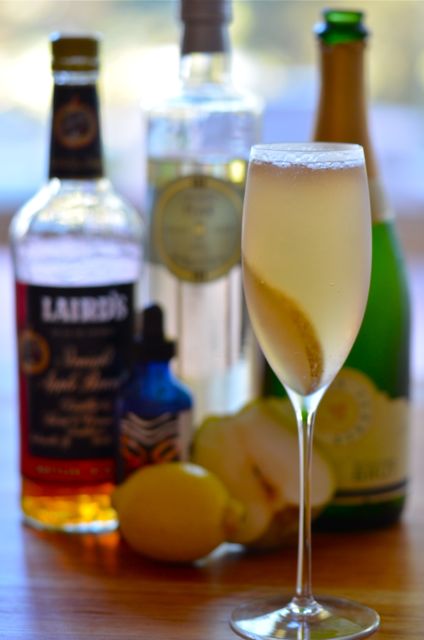
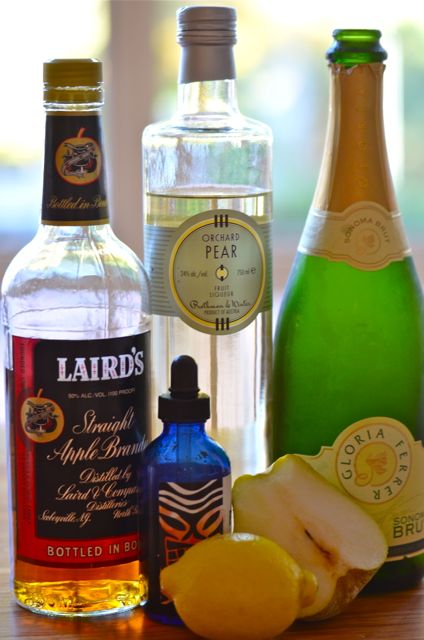
    The Rochelle-Normande combines pear liqueur, applejack (or calvados), lemon juice, Bittermen’s Tiki Bitters (substitute Angostura) and champagne. We garnish with a slice of pear and lemon twist. The sip is crisp and dry with both apple and pear flavors and aromas showing through. The lemon juice adds some acidity and the finish shows off the allspice, cinnamon and clove notes of the tiki bitters. A tasty, if somewhat dry, seasonal cocktail for the holidays. (And we like the look of the pear slice in the champagne flute.)

    You might note a lack of overtly sweet ingredients in this cocktail, and we did experiment both with Domaine de Canton to add sweetness and ginger notes and muddled pears. But muddled pears get gritty and the Canton did not play as well with the pears as we expected. In the end, we like the aroma and dry notes from both the pear liqueur and apple brandy and decided to highlight them. And the name? La Rochelle-Normand is an area in Normandy known for growing apples and pears. So while making this cocktail was challenging, finding the name was easy.

    The Rochelle-Normande:

    Ingredients:

    • 3/4 oz. applejack or Calvados
    • 3/4 oz. pear liqueur (Rothman & Winter Orchard Pear)
    • 1/3 oz. fresh lemon juice
    • 3 dashes Bitterman’s Elemakule Tiki Bitters (or Angostura bitters)
    • 4 oz. Champagne or sparkling wine
    • Pear wedge, for garnish (optional, but nice)
    • Lemon twist, for garnish

    Assemble:

    1. Combine the applejack, pear liqueur, lemon juice and bitters in a cocktail shaker with ice. Shake thoroughly and strain into a chilled flute. Top with the Champagne and then add the pear wedge and lemon twist. Serve.